


If your accounting firm is evaluating FP&A software, both Jirav and Cube will likely appear on your shortlist. Both platforms offer financial modeling, forecasting, and reporting. Both integrate with popular accounting systems. And both position themselves as modern alternatives to building everything in Excel.
But these tools were built for different buyers, and understanding that distinction will save you months of implementation time and frustration.
Cube is a spreadsheet-native FP&A platform designed primarily for internal finance teams — the VP of Finance or FP&A Manager at a single company who needs to centralize data, automate consolidation, and build reports for their leadership team. Jirav is purpose-built for accounting firms — practices that deliver FP&A advisory as a service across many clients, each with their own chart of accounts, industry dynamics, and reporting requirements.
That difference in design philosophy shows up in every layer of the product, from onboarding to modeling to client delivery.
Quick Comparison: Jirav vs Cube
|
Feature |
Jirav |
Cube |
|
Built For |
Accounting firms delivering FP&A advisory across multiple clients |
Internal finance teams at a single company (SMB to mid-market) |
|
Multi-Client Management |
Designed for it: clone models, standardize blueprints, manage across client portfolio |
Single-company focus; multi-entity support but not multi-client practice management |
|
Financial Modeling |
Driver-based 3-statement modeling with industry blueprints |
Spreadsheet-native modeling in Excel/Google Sheets with cloud data layer |
|
Scenario Planning |
Multi-scenario with cash flow impact, side-by-side comparison |
Scenario support with version control in spreadsheet environment |
|
Workforce Planning |
Dedicated module integrated into financial model |
Limited; noted as a gap in user reviews |
|
Reporting |
Pre-built templates, branded packages, automated delivery |
Excel/Sheets-based reporting with Cube Workspace dashboards |
|
Industry Blueprints |
Pre-configured templates for SaaS, professional services, nonprofit, product businesses |
No industry-specific templates |
|
Integrations |
QuickBooks, Xero, NetSuite, Sage Intacct, ADP, Gusto, Excel |
QuickBooks, NetSuite, Salesforce, Excel, Google Sheets, broad ERP connectors |
|
Interface |
Purpose-built web application with structured modeling environment |
Spreadsheet-native: works inside Excel and Google Sheets |
|
Pricing |
Custom per client wholesale pricing for accounting firms |
Starts at ~$1,250/month (Essentials); ~$2,450/month (Premium) |
|
Best For |
Firms scaling advisory across 10+ clients who need standardized, repeatable FP&A delivery |
Internal FP&A teams that want to stay in Excel but need centralized data and automation |
The Core Difference: Multi-Client Practice vs. Single-Company FP&A
This is the distinction that matters most, and it is not immediately obvious from feature lists alone.
Cube was founded by a three-time CFO who built the tool to solve the problems internal finance leaders face: disconnected spreadsheets, manual data consolidation, version control chaos, and the inability to get a single source of truth for budgets and forecasts. These are real problems, and Cube solves them well for companies whose finance team lives in Excel.
Jirav was built with a different problem in mind: how does an accounting firm deliver sophisticated financial planning across dozens of clients without building and maintaining a custom Excel model for each one? The answer is a platform that combines standardized modeling frameworks with client-specific customization — what Jirav calls Blueprints.
Blueprints and Multi-Client Scalability
Jirav’s Blueprint system lets firms configure a financial model template for a specific industry — SaaS, professional services, product-based businesses, nonprofits — and deploy it across new clients in minutes. Each blueprint includes KPI definitions and report packages tailored to that industry's metrics and language. Firms will also add in additional revenue and expense models to those templates as well.
When you onboard a new SaaS client, for example, you do not start from a blank canvas. You connect their accounting data, apply the SaaS blueprint, and immediately have a three-statement financial model with MRR, churn, CAC, and LTV metrics built in. Customization happens on top of this foundation, not from scratch.
Cube does not offer this kind of multi-client scaffolding. It is designed for a single finance team working on their own company’s data. If you are an accounting firm trying to use Cube across 20 clients, you would essentially be managing 20 separate Cube instances without the standardization layer that makes the work repeatable and scalable.
Modeling Approach: Structured Environment vs. Spreadsheet Freedom
Cube’s biggest selling point is that it lets finance teams continue working in Excel and Google Sheets while adding a centralized cloud data layer underneath. For internal FP&A teams that have years of institutional knowledge baked into their spreadsheets, this is a meaningful advantage — it avoids the disruption of learning an entirely new modeling paradigm.
Jirav takes a different approach. Rather than layering on top of spreadsheets, Jirav provides a structured modeling environment where forecasts are built using driver-based assumptions within the platform. Revenue is modeled by its drivers. Expenses are linked to the operational variables that cause them. Everything connects to a three-statement output — P&L, balance sheet, and cash flow — automatically.
The trade-off is real: Cube gives you more spreadsheet freedom, while Jirav gives you more modeling structure. For a single company with a mature finance team and complex legacy models, Cube’s approach makes sense. For an accounting firm that needs to build, maintain, and update financial models across many clients efficiently, Jirav’s structured approach reduces errors, accelerates onboarding, and makes it possible for junior team members to maintain models built by senior advisors.
Reporting and Client Delivery
Cube’s reporting strength is in the web-based Cube Workspace, which provides dashboards and drill-down capabilities for internal teams. Reports can be built and shared, and the platform supports version control and collaboration features that help finance teams work together on budgets and forecasts.
However, multiple user reviews note that Cube’s dashboard visualization is limited compared to dedicated reporting tools, and that formatting Excel-based reports for external consumption requires additional work.
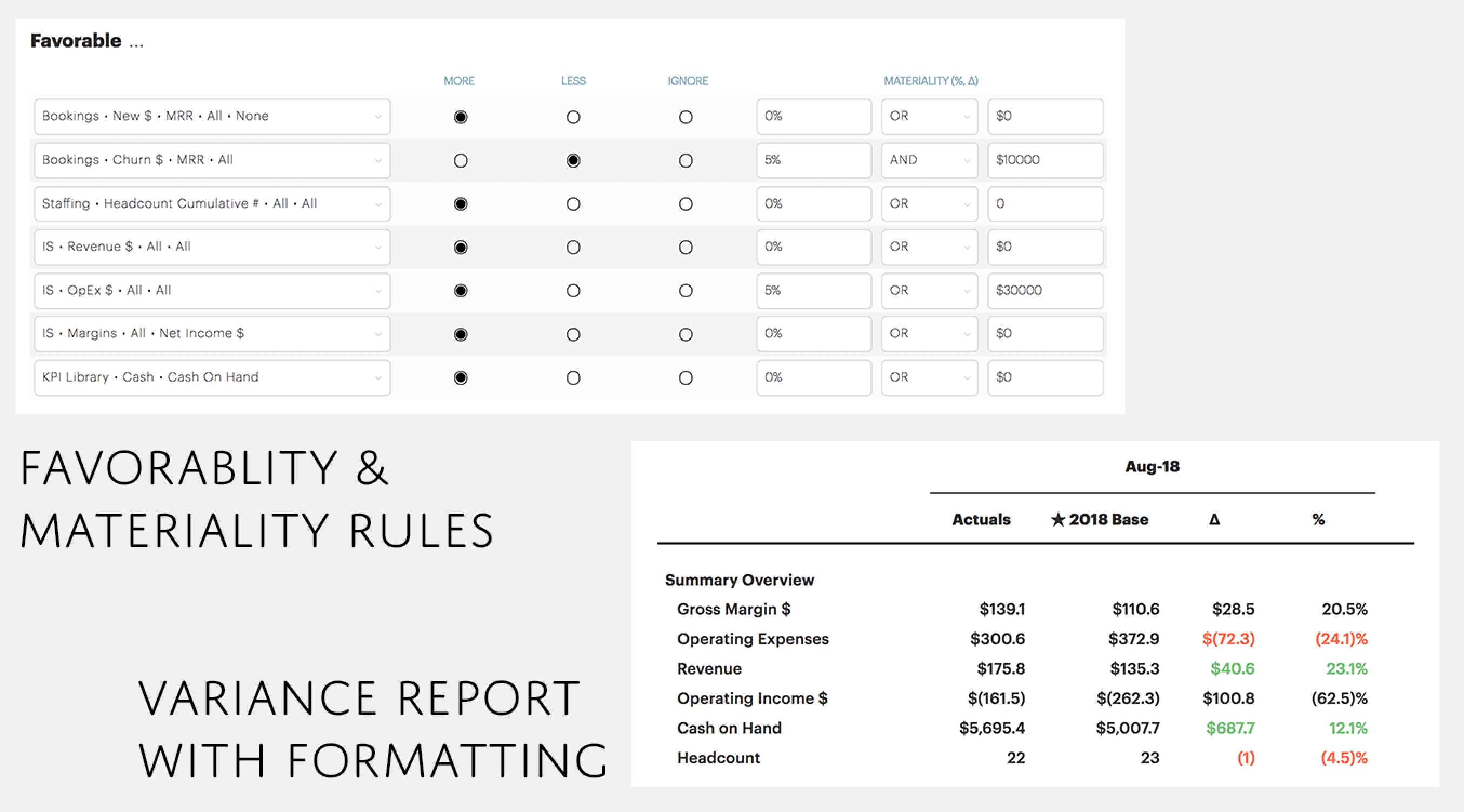
Jirav’s reporting is built specifically for client delivery. Report packages can be branded with your firm’s identity, configured once, and reused across clients. Reports pull directly from the financial model, showing actuals, budget, forecast, and variance in a single view. Packages can be exported to PDF, shared via link, or delivered automatically — features designed for firms that need to produce polished, external-facing deliverables at scale.
Who Should Choose Cube?
Cube is a strong choice for:
- Internal FP&A teams at SMBs or mid-market companies that want to centralize their data without abandoning Excel
- Finance leaders who have complex, mature spreadsheet models they want to enhance rather than rebuild
- Companies that need broad ERP and CRM integration (NetSuite, Salesforce, etc.) for a single-company data hub
- Teams where the primary audience for reports and analysis is internal leadership, not external clients
Who Should Choose Jirav?
Jirav is the better fit for:
- Accounting firms delivering FP&A advisory as a service across a portfolio of clients
- Practices that need to onboard new clients quickly using industry-specific model templates rather than building from scratch
- Firms whose clients have bank debt, board reporting, or investor expectations that require driver-based, three-statement financial models
- Advisory practices replacing Excel with a platform that scales modeling, reporting, and client delivery under one roof
- Teams that need workforce planning directly integrated into the financial model for accurate headcount and compensation forecasting

The Bottom Line
Jirav and Cube are both capable FP&A platforms, but they were built to solve different problems for different buyers.
Cube is an excellent tool for bringing order to a single company’s financial planning workflow. If you are a VP of Finance who needs to stop emailing spreadsheets around and start working from a centralized data layer, Cube delivers on that promise.
Jirav is built for the accounting firm that views FP&A advisory as a scalable service line. The ability to standardize models across industries, onboard clients in minutes instead of weeks, and deliver branded, forward-looking financial packages — these are not add-on features. They are the core of what makes Jirav different.
For firms whose advisory work needs to scale efficiently across a growing client base, the purpose-built approach saves time where it matters most: in the work you repeat every month for every client.
See how Jirav is built specifically for accounting firms delivering FP&A advisory. Request a demo.