

The most valuable question a client can ask their accountant isn't 'how did we do?' It's 'what should we do next?'
The first question is the domain of traditional accounting: financial statements, tax returns, management reports, performance dashboards. These are essential services, and most accounting firms deliver them well. But they're also increasingly commoditized, often automated, and under consistent margin pressure as technology makes basic bookkeeping and reporting faster and cheaper.
That second question is the domain of FP&A advisory. And it is the question that clients are asking with increasing urgency and frequency.
This guide covers everything accounting firms and fractional CFO practices need to know about building, pricing, and scaling an FP&A advisory service line: what FP&A advisory is, who the right clients are, what the core deliverables look like, how to build a practice around them, and what technology infrastructure is required to deliver them at scale.
What Is FP&A Advisory?
Financial Planning and Analysis (FP&A) advisory is the set of services centered on building and maintaining forward-looking financial models, forecasts, and plans for client businesses. Where traditional accounting looks backward (recording, categorizing, and reporting what already happened), FP&A advisory looks forward: modeling what will happen under different assumptions, quantifying the financial impact of decisions before they're made, and giving clients the analytical infrastructure to operate with financial clarity.
The core FP&A advisory deliverables are:
- Driver-based financial models that connect operational assumptions (headcount, pricing, growth rates, expense ratios) to a fully linked income statement, balance sheet, and cash flow statement.
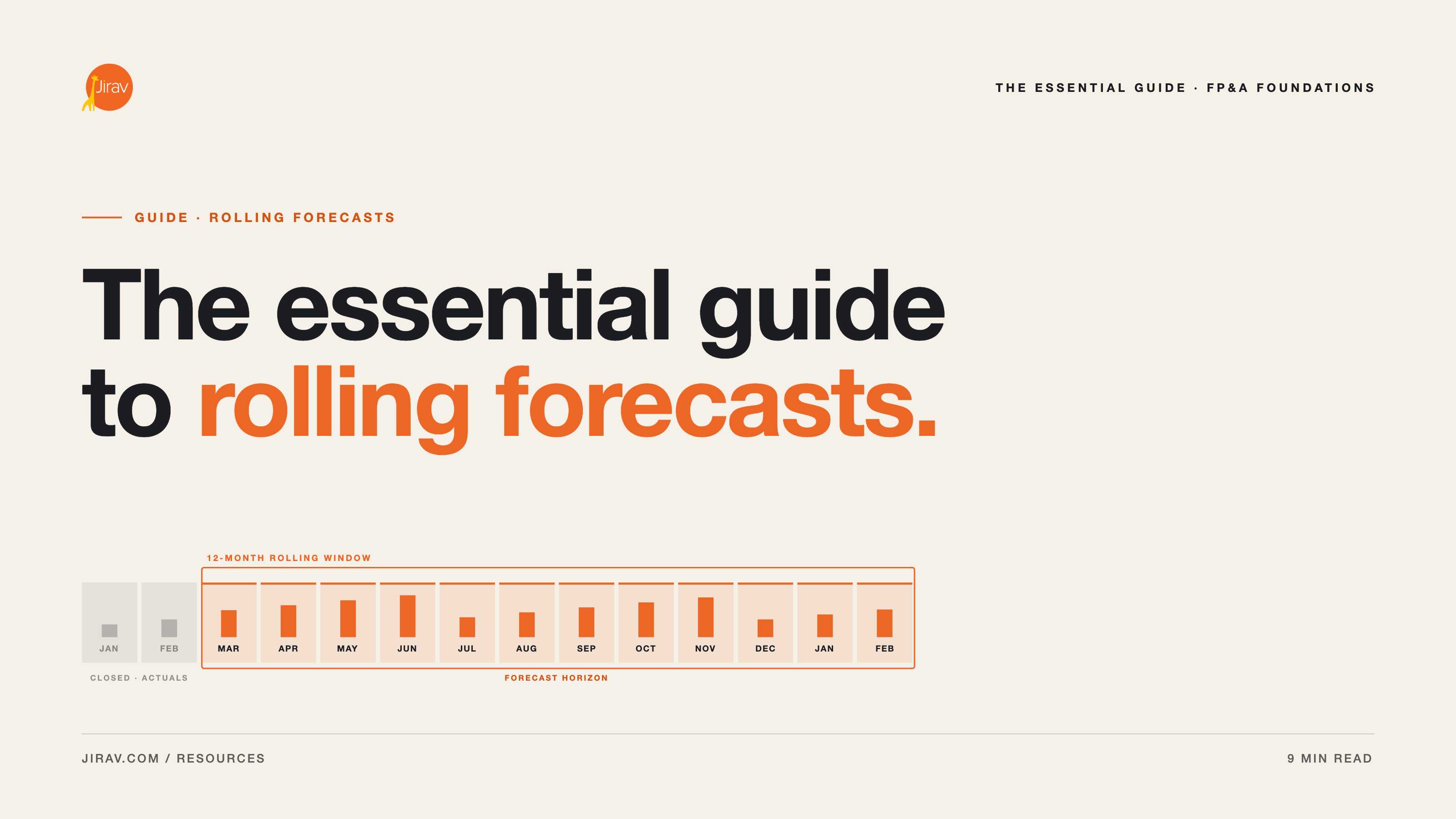
- Rolling forecasts that update continuously as actuals come in, extending the planning horizon and replacing the static annual budget as the primary navigation tool.
- Scenario analyses that quantify the financial impact of specific decisions before they're made: hire plans, expansion scenarios, pricing changes, acquisition modeling, and covenant stress tests.
- Board and investor reporting that translates the model into communication-ready materials for lenders, investors, and boards.
FP&A advisory requires a different skill set than traditional accounting, a different engagement model, and different technology. But the market for it is large and growing, and accounting firms are in a naturally strong position to capture it, given their existing client relationships, financial expertise, and access to the accounting data that powers every FP&A model.
FP&A Advisory vs. Accounting and Reporting: The Core Distinction
The clearest way to understand FP&A advisory is to contrast it with the work most accounting firms already do. The distinction is not about complexity or value; it's about orientation and purpose. Both serve important functions.
|
Dimension |
Traditional Accounting / Reporting |
FP&A Advisory |
|
Time orientation |
Backward-looking: records and reports what happened |
Forward-looking: models and forecasts what will happen |
|
Primary output |
Financial statements, management reports, dashboards |
Driver-based models, rolling forecasts, scenario analyses |
|
Core question answered |
How did we perform? |
What happens next under different assumptions? |
|
Update cadence |
Monthly or quarterly close cycles |
Continuous; model updates as actuals arrive |
|
Value to client |
Compliance, accuracy, performance visibility |
Decision support, risk quantification, stakeholder confidence |
|
Pricing structure |
Hourly or fixed-fee per engagement |
Monthly retainer plus one-time model build fee |
Many accounting firms already do some FP&A work informally: a client asks for a cash flow projection, you build it in Excel, you deliver it. But 'informal FP&A' and 'FP&A advisory as a defined service line' are different things. The former is reactive, inconsistently scoped, and impossible to scale. The latter is deliberate, repeatable, and priced to reflect its value.
It's also worth distinguishing FP&A advisory from financial reporting tools. Platforms like Fathom are excellent at taking accounting data and presenting it beautifully: KPI dashboards, management reports, variance analysis. That's reporting. FP&A advisory involves building the forward-looking model that tells you where the business is going, not just where it's been. Reporting tells you the score. FP&A tells you the game plan.
Why Demand for FP&A Advisory Is Growing
The demand for forward-looking financial guidance from accounting firms has been building for years, driven by a few reinforcing trends.
The advisory gap in the market
The market for traditional accounting services is efficient and competitive. Bookkeeping and basic tax services are increasingly commoditized, with technology driving down the cost of basic compliance work. Firms competing only on compliance are facing margin compression and client attrition to lower-cost providers.
FP&A advisory occupies a different competitive space. It requires expertise, judgment, and ongoing relationship management that can't be automated away. The firms that have built FP&A advisory practices report higher client retention, higher revenue per client, and stronger referral networks than firms focused primarily on compliance.
The business decision complexity problem
Small and mid-market businesses are making more complex financial decisions than ever: raising capital, managing covenant-laden debt, hiring aggressively in competitive labor markets, expanding into new geographies. These decisions require financial modeling, not just reporting. And most business owners and operators don't have the internal expertise to build or maintain that modeling infrastructure, which is exactly where accounting firms can step in.
The CFO talent gap
Full-time CFOs are expensive and often out of reach for smaller companies. Fractional CFO and advisory firms have grown significantly over the past decade, serving the market of companies that need CFO-level financial guidance without the overhead of a full-time executive. FP&A advisory is the operational backbone of the fractional CFO model: the modeling and forecasting work that makes strategic CFO guidance actionable.
The Core FP&A Service Offerings
FP&A advisory encompasses a range of services, and most firms start with a subset before expanding. The table below maps the primary service categories to their deliverables and the client segments they serve.
|
Service |
What It Involves |
Who Needs It Most |
|
Annual Budgeting & Planning |
Building the operating budget for the coming year: headcount plans, departmental budgets, revenue targets by segment, and capital expenditures tied to strategic initiatives |
Companies preparing for a new fiscal year; firms with lender or board reporting requirements |
|
Rolling Forecast Maintenance |
Importing monthly actuals, updating driver assumptions, extending the forecast horizon, and delivering a revised 12–18 month outlook each month |
Growth-stage companies, businesses with variable revenue, any client making regular operating decisions based on cash position |
|
Scenario Planning |
Modeling the financial impact of specific decisions before they're made: new hires, acquisitions, price changes, market exits, capital raises |
Companies facing strategic decisions with significant financial consequences; clients preparing for fundraising |
|
Board & Investor Reporting |
Translating the financial model into presentation-ready materials — board decks, investor updates, lender packages — with plan-vs-actual analysis and forward-looking narrative |
Investor-backed companies, businesses with active lender relationships, clients preparing for acquisition conversations |
|
KPI & Driver Framework Design |
Identifying the operational metrics that drive financial performance, building the measurement infrastructure, and connecting KPIs to financial model assumptions |
Clients whose financial model lacks a clear driver structure; early-stage companies formalizing their metrics |
For firms launching their first formal FP&A service line, annual budgeting and rolling forecast maintenance are typically the strongest starting points. They have the most consistent client demand, the clearest deliverable scope, and the most natural upgrade path from existing accounting services.
Who Are the Right Clients for FP&A Advisory?
Not every accounting client needs FP&A advisory, and not every client is a good fit for it. The clients who get the most value from FP&A advisory share common characteristics: they make significant financial decisions regularly, they operate in conditions of meaningful uncertainty, and they're asking forward-looking questions that reporting-only services can't answer.
Strong ICP signals
The clearest indicators of FP&A advisory readiness in your existing book of business:
- Growth-stage companies adding headcount, opening locations, or entering new markets, where the financial impact of strategic decisions is large and the margin for error is narrow.
- Businesses with active lender relationships or covenant requirements, where a defensible and continuously updated forecast is a contractual necessity, not an optional management tool.
- Companies preparing for fundraising (equity rounds, SBA loans, or acquisition conversations) where the financial model will face external scrutiny from investors or lenders.
- Clients who are currently asking 'what if' questions that you're answering with ad-hoc spreadsheet work. They're already signaling that they need FP&A advisory.
Anti-ICP signals
Some clients are not good fits for FP&A advisory, and taking them on early can create delivery problems and dilute the practice's positioning:
- Businesses whose primary financial need is cleaner reporting, not forward-looking analysis. If the client request is 'I want better dashboards,' that's a reporting engagement. Valuable work, but a different kind.
- Companies with messy books or inconsistent accounting that hasn't been cleaned up. A financial model is only as good as the historical data it's built on. Clients with unreliable actuals will produce unreliable models and dissatisfied advisory relationships.
- Very early-stage businesses where the uncertainty in the model is so high that even a well-built forecast has limited decision-making value. These clients often need advisory guidance more than financial modeling.
Building the FP&A Advisory Practice: People, Process, and Technology
A scalable FP&A advisory practice requires investment in all three dimensions: the right people to do the work, repeatable processes to deliver it consistently, and technology infrastructure that doesn't break as the client base grows.
People
FP&A advisory work requires financial modeling expertise, not just accounting knowledge. The relevant skills (driver-based modeling, 3-statement construction, scenario analysis, assumption documentation) are distinct from compliance and reporting skills, and they're not universal in accounting firm talent pools. Firms building FP&A practices typically hire dedicated FP&A analysts or upskill existing staff through targeted training, and they build capacity before demand arrives, not after.
Process
Repeatable delivery is the difference between a scalable practice and a collection of demanding client engagements. Every client engagement should follow the same onboarding structure (data integration, model build, assumption documentation), the same monthly cadence (actuals import, variance analysis, forecast update, client delivery), and the same output standards (consistent report formats, standardized commentary structure, template-driven presentations). The more standardized the delivery process, the more clients a given team can serve.
Technology
Technology is where the most significant leverage in FP&A advisory lives, and where the most common bottleneck appears. Most accounting firms begin their FP&A work in Excel, and Excel is where most of them eventually stall.
The Technology Question: Why Excel Isn't Enough
Excel remains the default tool for financial modeling across the industry, and it's easy to understand why. It's familiar, it's flexible, and it works well for one-off analyses and early-stage model builds. The problems emerge at scale. When a practice manages ten, fifteen, or twenty active client models simultaneously, the failure modes that are manageable at small scale become serious operational and reputational risks. Version control breaks down. Formula errors accumulate undetected. Collaboration becomes impossible. Monthly update cycles expand from hours to days. For a comprehensive breakdown of where and why Excel fails in multi-client FP&A environments, including the research on error rates and the real-world examples of failures at major financial institutions, see Why Excel Breaks When FP&A Gets Serious.
The practical implication for FP&A advisory practices is straightforward: Excel is a starting point, not an endpoint. The firms that build durable, scalable practices transition to purpose-built FP&A software before they need to, not after they've already hit the wall.
What to Look for in FP&A Software
Not all FP&A software is built for multi-client advisory use. Many platforms are designed for internal finance teams at single companies and lack the multi-client management features, integration breadth, and collaboration controls that accounting firms need. When evaluating FP&A software for a client-facing advisory practice, the following capabilities matter most:
|
Capability |
Why It Matters for Multi-Client Advisory |
|
Driver-based 3-statement modeling |
Enables the kind of assumption-driven forecasting that stands up to bank and investor scrutiny — not just top-down projections |
|
Direct GL integrations |
Automated actuals import eliminates manual data entry and reduces the risk of the copy-paste errors that are endemic to Excel-based workflows |
|
Multi-client management |
The ability to manage multiple client models within a single platform, with clear separation and no risk of cross-contamination between files |
|
Scenario and version control |
Unlimited scenarios with full audit trail — so you can present three options to a client and track which assumption set they chose to plan against |
|
Client-facing reporting |
Built-in dashboards and report templates that produce client-ready deliverables without requiring design work or manual formatting |
|
Collaboration and access controls |
Controlled client access so they can view their model and dashboard without the risk of overwriting assumptions or accessing other client data |
The distinction between platforms built for internal finance teams and platforms built for accounting and advisory firms is meaningful. Tools optimized for a single-company user experience often require significant workarounds to manage multiple client models safely and efficiently. Platforms built for multi-client advisory use address those problems architecturally.
Launching Your FP&A Service Line
Building an FP&A advisory service line from scratch involves decisions about service design, initial client selection, pricing structure, and delivery infrastructure. The most important of these decisions is starting with a clearly defined service offering: specific deliverables, a specific client profile, and a specific pricing structure. Launching with a vague 'we do FP&A advisory' positioning creates scope ambiguity from the first client conversation.
For a detailed step-by-step guide to launching FP&A advisory services, including how to define your initial service offering, identify the right first clients, build a repeatable delivery system, and avoid the most common early-stage mistakes, see How to Launch FP&A Advisory Services at Your Accounting Firm.
Pricing and Packaging FP&A Advisory
FP&A advisory should be priced on a monthly retainer model, with a one-time model build fee for initial setup. Hourly billing undervalues the expertise component, creates adverse incentives as the practice becomes more efficient, and frames the engagement as a cost rather than an investment. Retainer pricing aligns the firm's incentives with the client's outcomes, creates predictable revenue for the practice, and anchors the advisory relationship as a strategic service rather than a transactional one.
A tiered service structure, with entry, standard, and premium tiers defined by deliverables rather than just price, simplifies the sales conversation and creates natural expansion paths as advisory relationships deepen. Initial model build fees should always be scoped and quoted separately; rolling them into the first month's retainer is the single most common pricing mistake when launching advisory services.
For a full pricing framework, including benchmark retainer ranges, scoping guidance, value-based pricing principles, and how to structure the sales conversation, see How to Price FP&A Advisory Services: A Framework for Accounting Firms.
Scaling Across Multiple Clients
The unit economics of FP&A advisory improve significantly as a practice scales, but only if the delivery infrastructure keeps pace with client growth. Firms that try to scale FP&A advisory without systematizing their delivery process and investing in the right technology tend to hit a ceiling around five to eight active clients, where the overhead of maintaining individual models and delivering custom outputs consumes the margin from new clients.
The levers that enable scaling are all on the delivery side: industry templates that can be applied across clients with consistent structure, standardized report formats that require configuration rather than design from scratch, and FP&A software that manages the data integration, version control, and collaboration overhead that Excel can't handle at scale.
The practices that have built the most successful multi-client FP&A advisory services invest in delivery infrastructure early, before they need it, and price their services high enough that the economics support that investment. Starting with five clients and the delivery infrastructure for twenty is not over-engineering. It's building a practice that can actually grow.
See how accounting and fractional CFO firms are scaling their advisory practices with Jirav → Customer Stories
The FP&A Advisory Opportunity
The market for FP&A advisory among accounting firms is large, underserved, and structurally well-positioned for practices that make the investment to build it correctly. Clients are asking the forward-looking financial questions. The demand is there.
The practices that capture that demand are the ones that build deliberately: with clearly defined services, the right client selection criteria, pricing that reflects the value delivered, delivery systems that scale, and technology infrastructure that supports multi-client management without the failure modes that make Excel a liability at scale.
The guide above maps the territory. The rest is execution.
|
Jirav is purpose-built for accounting firms and fractional CFO practices delivering FP&A advisory at scale. Driver-based 3-statement modeling, direct GL integrations, multi-client management, and client-ready reporting: everything your practice needs to deliver advisory work that commands premium retainers. |