


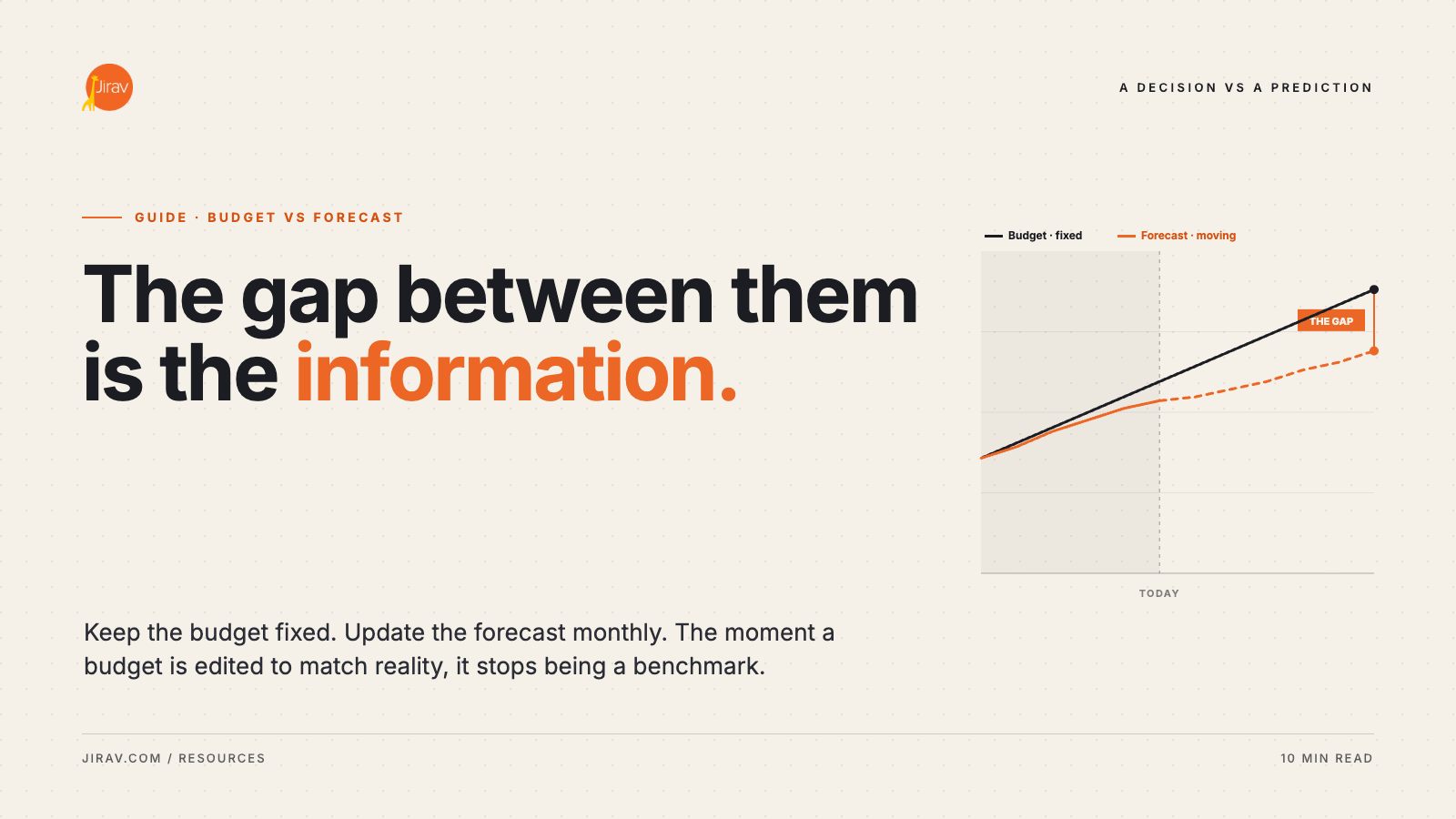
A budget is a fixed commitment: what the business has decided to spend and expects to earn over a set period, with named owners, approved once and then held still. A forecast is a moving expectation: the current best estimate of where the business will actually land, updated as real results arrive. The budget is a decision. The forecast is a prediction. They are not two versions of the same document, and the distance between them is the most useful management information a finance function produces.
|
Budget |
Forecast |
|
|---|---|---|
|
Purpose |
Allocate resources and set accountability |
Anticipate outcomes and inform decisions |
|
Changes? |
Fixed once approved |
Updated on a regular cadence |
|
Horizon |
Fiscal period, usually one year |
Rolling, typically 12 to 18 months forward |
|
Owner |
Department heads who agreed to it |
Finance, with input from the business |
|
Measured by |
Variance against actuals |
Accuracy against actuals |
|
Question it answers |
What did we commit to? |
Where are we actually heading? |
Why does the distinction matter in practice?
Because the moment a budget is edited to reflect current reality, it stops being a benchmark. Variance analysis compares actuals to a commitment. If the commitment moves every time results disappoint, the variance is always near zero and the report tells you nothing.
This is the most common failure in finance functions of every size, and it rarely happens deliberately. It happens because someone needs an updated view, the budget file is the file that exists, and updating it seems easier than maintaining two. Six months later nobody can answer a simple question: did we spend what we said we would, and if not, where did it go?
Keeping them separate produces three things a merged file cannot:
- Accountability. A department head can be held to a number they agreed to, because that number still exists in its original form
- A learning loop. Comparing the original budget to actuals over several cycles reveals which assumptions the organization systematically gets wrong
- An early warning. The gap between the fixed budget and the current forecast is the clearest signal available that the year is drifting, and it appears months before it shows up in cumulative variance
How often should the forecast be updated?
Monthly, tied to close, for most businesses. Quarterly is defensible for a stable business with long cycles and low volatility. Anything less frequent is not a forecast, it is a stale budget with a different label.
The constraint is usually cycle time rather than judgment. AFP’s FP&A research found that the finance teams it classifies as agile reforecast in an average of 9.4 days against 14.5 days for their peers, more than 50 percent faster. That difference compounds. A team that needs three weeks after close to produce a forecast is delivering a forward view that is already a month stale on arrival, which is why the reforecast quietly becomes quarterly, then annual, then nonexistent.
The same research found agile teams were far more likely to use multiple scenarios in planning, with 94 percent agreeing that FP&A uses multiple scenarios. The two findings are related: teams that can reforecast quickly can also produce alternatives quickly, because both capabilities come from the same underlying property, which is a model where drivers can be changed without rebuilding the output.
Should the forecast horizon roll forward?
Yes, and this is where most forecasts fail structurally. A forecast that ends at fiscal year end offers eleven months of visibility in January and one month in November. Visibility contracts exactly as the decisions get more consequential.
A rolling forecast holds the window constant, typically 12 to 18 months forward, extending a period each time one closes. The annual budget still exists and still gets defended. The forecast just refuses to run out of runway. The mechanics of setting this up, including how to handle the budget-to-forecast handoff at year end, are covered in our guide to rolling forecasts.
What should variance analysis actually measure?
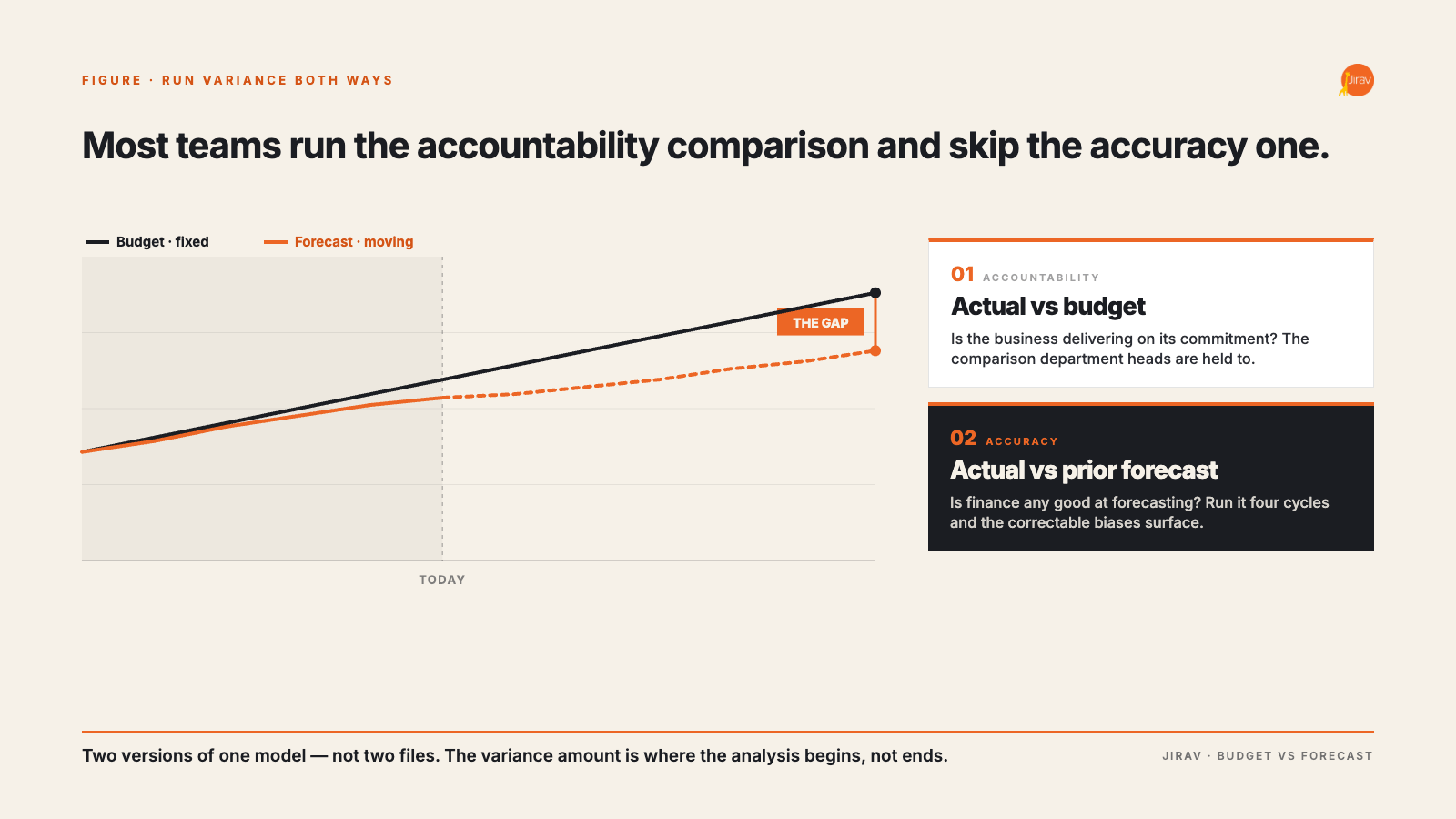
There are two comparisons worth running every month, and most teams run only one.
Actual versus budget answers whether the business is delivering on its commitment. This is the accountability comparison, and it is the one department heads are held to.
Actual versus prior forecast answers whether finance is any good at forecasting. This is the accuracy comparison, and it is almost universally skipped. The 2026 AFP FP&A Benchmarking Survey found that only 14 percent of finance teams formally track forecast accuracy. The remaining 86 percent produce the single most consequential output of the function with no quality measure attached to it.
The second comparison is where the improvement comes from. Run it for three or four cycles and patterns surface fast: revenue timing consistently optimistic by two weeks, hiring consistently later than planned, a specific expense category that is always underestimated. Those are correctable biases, and correcting them is worth more than any amount of additional precision in the original assumptions.
In both cases the variance amount is the beginning of the analysis, not the end. A report showing marketing 12 percent over plan is a reporting output. Explaining that the overage is a timing shift from a contract that started early, that it does not change the full-year total, and that the Q2 budget is correspondingly light, is an FP&A output. The difference is whether the model can trace the variance back to the driver that caused it.
When does the budget get rebuilt?
Once a year, on a schedule, and ideally later than instinct suggests. APQC’s benchmarking data puts top performers at the 25th percentile completing the annual budget in 28 days or less, close to twice as fast as organizations at the 75th percentile. One of APQC’s recommendations runs against the grain: start later. A process that begins in June depends heavily on forecasting the back half of the year, which invites revision and drags the cycle out. Starting closer to year end means more of the base is actual, and there is correspondingly less to argue about.
The exception to the once-a-year rule is a genuine reset: an acquisition, a major pivot, a funding event, a market shift that makes the original plan meaningless. In that case, reset the budget deliberately, mark the date, and keep the original for comparison. What breaks the discipline is not the reset, it is the quiet rolling edit that leaves no record of what was originally committed.
Running both without doubling the work
The practical objection to maintaining a budget and a forecast separately is effort, and in a spreadsheet the objection is fair. Two files means two chart of accounts mappings, two sets of formulas, and a reconciliation problem every month. Most teams that collapse the two are responding rationally to a tooling constraint.
The constraint disappears when the budget and the forecast are two versions of one model rather than two files. Jirav is built this way: a driver-based model where the approved budget is held as a fixed version, the forecast updates against the same structure as actuals load, and variance reporting runs across both without a reconciliation step. Because the model produces three-statement output, a change to a forecast driver flows through the P&L, the balance sheet, and cash rather than stopping at the income statement.
Two capabilities do most of the work here. Plans can be set to roll forward automatically as periods close, which removes the manual step that usually kills the rolling forecast discipline. And Auto Forecast generates a baseline from historical results and seasonal patterns, which is a starting point for the reforecast conversation rather than a replacement for judgment. For advisory firms, the leverage is that this structure is reusable across a client base, so the monthly cadence becomes a repeatable process rather than a bespoke project per client. The reporting and dashboards layer then delivers the budget-versus-actual package without a separate assembly step.
Where do plans and targets fit?
Four terms get used interchangeably in most organizations, which is a large part of why the discipline breaks down. They are distinct instruments with distinct jobs.
The strategic plan is the multi-year shape of the business: which markets, which products, what scale, and the financial structure implied by those choices. It is directional rather than precise, and it sets the parameters the budget is built inside.
The budget converts one year of that plan into a resource commitment with owners. Precise, fixed, and negotiated.
The forecast is the current expectation. Precise, moving, and owned by finance.
The target is what leadership wants, which is frequently above both the budget and the forecast. Targets are legitimate management tools and they are not the same thing as a plan. The problem starts when a target is entered into the model as if it were a forecast. Now the forward view reflects an aspiration rather than an expectation, cash planning is built on it, and the first genuinely bad month arrives as a surprise.
A useful test for any number in a finance conversation: can you name the drivers that produce it, and would you bet on it? If the answer to the first is no, it is a target. If the answer to the first is yes and the second is no, someone has confused the budget with the forecast.
Four mistakes that break the discipline
- Editing the budget in place. The single most damaging one, because it happens gradually and leaves no trace. Lock the approved version and make it structurally difficult to change
- Forecasting only the P&L. A forward view that does not carry through to the balance sheet and cash flow cannot answer the question that actually matters, which is whether the business has the cash to execute the plan. This is a modeling problem, not a discipline problem, and it is why three-statement output has to come out of the model rather than be assembled after it
- Reforecasting by adjusting outputs. Overwriting a revenue line to match the new expectation produces a number without a driver behind it. The next question, which is always why, has no answer, and the following month’s forecast has nothing to build on
- Treating the annual budget as the only committed number. Departments need quarterly phasing they agreed to, or the first three quarters of variance analysis are just timing noise and the real overspend surfaces in Q4
How this changes the client conversation
For advisory firms, the budget-versus-forecast discipline is not an internal hygiene issue. It is the structure of the monthly client meeting, and it is what separates an advisory conversation from a reporting handoff.
A reporting conversation covers what happened last month. An advisory conversation covers three things in sequence: here is where you are against what you committed to, here is where we now expect the year to land, and here is what would change that. The first is the budget comparison. The second is the forecast. The third is scenario work, which our practical guide to scenario planning covers in more depth.
That sequence only works if the budget is still intact. A firm that has been editing the client’s budget in place all year has no first item, which means the meeting opens on a forecast the client has no way to evaluate. The discipline is what makes the conversation possible.
The short version
Keep the budget fixed. Update the forecast monthly. Roll the forecast horizon forward so visibility never contracts. Run variance both ways, against the budget for accountability and against the prior forecast for accuracy. And make sure the model can explain a variance in terms of the driver that caused it, because a number without a cause is a report, not analysis. If the underlying structure is not solid enough to support both views, start with three-statement financial models and our guide to evaluating forecasting software.
|
Run the budget and the forecast on one model A fixed budget version, a rolling forecast that updates as actuals load, and variance reporting across both with no reconciliation step. Built for firms running a monthly cadence across a client base. |