

Every forecast is a single guess about an uncertain future. Scenario planning is what you do when one guess is not enough.
It is also a direct counterweight to a well-documented human bias. As McKinsey notes in its work on the use and abuse of scenarios, people instinctively expect the future to resemble the recent past and assume change will be gradual. Building a deliberate range of outcomes, each backed by the chain of events that would produce it, forces you to take seriously the futures your base case quietly ignores.
This is a practical guide for finance teams that already run a forecast and want to make scenario planning part of how they operate, with concrete examples rather than theory.
Scenario Planning vs. Sensitivity Analysis vs. Forecasting
These three terms get used interchangeably, and the confusion leads to weak planning. They are not the same thing.
- Forecasting produces your single best estimate of what will happen.
- Sensitivity analysis flexes one variable at a time to see how much it moves the outcome. Useful, but narrow.
- Scenario planning builds a small set of coherent, internally consistent stories about the future, each with a full and matching set of assumptions across the business.
The discipline is in the restraint. McKinsey's guidance on effective scenario planning warns against rushing to model dozens of variables before you have assessed which uncertainties actually matter. A handful of plausible, well-reasoned scenarios beats an infinite spread of half-built ones every time.

A Practical Framework
Good scenario planning follows a repeatable sequence. Five steps cover it.
- Anchor on the base case. Your current forecast is the reference point. Every scenario is a deliberate departure from it, which means the base case has to be trustworthy first.
- Find the few drivers that move the outcome. Not forty inputs, the three to five that genuinely swing the result: typically new bookings, churn, hiring pace, and one or two key costs. Scenario planning built on the wrong drivers just adds noise.
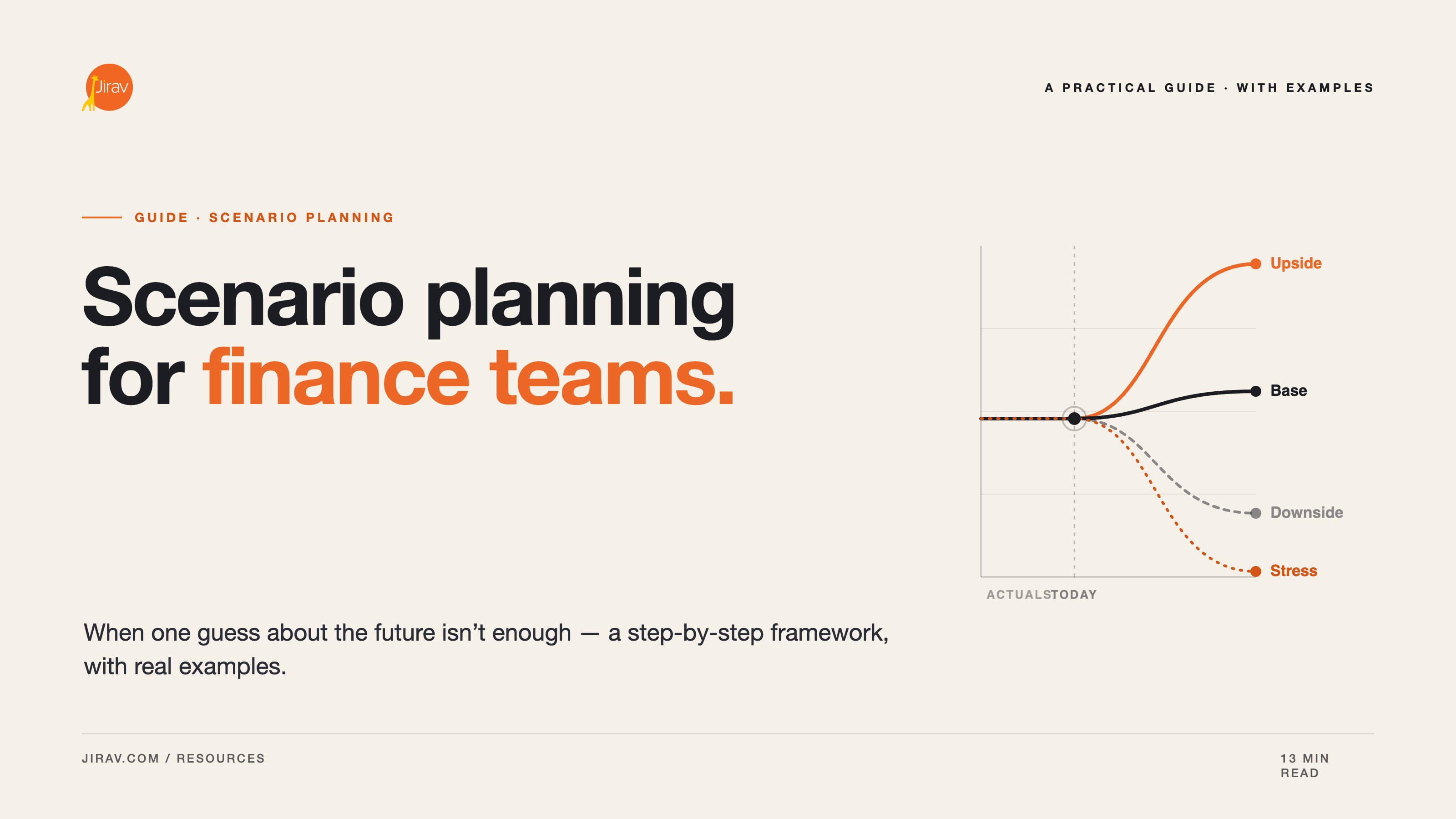
- Build a small set of scenarios. A workable default is base, downside, and upside, with a fourth stress case when liquidity is in question. Each one is a complete, consistent picture, not a single number nudged up or down.
- Model each across all three statements. Run every scenario through the income statement, balance sheet, and cash flow. The value of a downside is almost always the cash and runway answer, and you only see that if the balance sheet and cash flow move with the P&L.
- Define trigger points and pre-decided actions. Decide in advance which leading indicators tell you which scenario you are actually living in, and what you will do when one fires. This is the step that turns scenario planning from a slide into management.
Examples by Situation
The framework is easiest to see in the decisions finance teams face most often.
A hiring decision
You are weighing three new hires now versus waiting two quarters. Model both against a base and a downside, and look specifically at the cash trough in each. The question is rarely whether you can afford the hires in a good year. It is whether you can survive them in a bad one.
A pricing change
Model adoption and churn sensitivity together. A price increase that lifts revenue in the base case can be net-negative once a downside churn assumption is applied, and scenario planning surfaces that before you commit, not after.
A downturn
This is the classic four-scenario set: a best case, a worst case, a momentum case that simply continues the current trajectory, and a most-likely case. Assess each on the depth of the decline, how long it lasts, and how quickly the business can ramp back. The goal is to avoid lazily picking the middle scenario and calling it the plan.
An advisory client conversation
For an advisory firm, scenario planning is also a service. Walking a client through their own best and worst cases in real time, and showing the cash impact of each, is one of the clearest demonstrations of advisory value there is.
Why This Breaks in Spreadsheets
The reason most teams do not run scenarios as often as they should is mechanical. When each scenario is a separate file, you get version sprawl and stale assumptions almost immediately. By the time you finish building the third scenario, the base case has already moved, and reconciling them by hand is its own project. The friction quietly kills the practice.
This is where having scenario planning built into the model changes the economics of it. With Jirav, you clone the base case, change the handful of drivers that matter, and compare scenarios side by side across all three statements. Because actuals flow in from your accounting system automatically, the base case stays current, so your scenarios are always built on today's reality rather than last quarter's. The underlying driver-based model means a change to an assumption ripples through the income statement, balance sheet, and cash flow the way it would in real life.
From there, the planning and forecasting tools roll each scenario forward with Auto Forecast, and the reporting and dashboards turn the comparison into something a board or client can read at a glance.
Make It a Habit, Not an Event
The teams that get the most from scenario planning do not treat it as an annual fire drill. They keep a live base, upside, and downside, refresh them as actuals land, and revisit their trigger points every month. For advisory firms, it becomes a recurring deliverable that clients come to depend on, and you can see how firms operationalize that in Jirav's customer stories.
The Bottom Line
Scenario planning is not about predicting the future. It is about being ready for more than one version of it, and knowing in advance what you will do when each one arrives. If your current process makes that too slow to do regularly, see how Jirav handles scenario planning.