

Accounting firms spend their days helping clients measure performance, and surprisingly often fly blind on their own. The firms pulling ahead in advisory have closed that gap in both directions. They know precisely which numbers tell them whether the practice is healthy, and they put a sharp, forward-looking set of numbers in front of every client.
The stakes are real. Client advisory services is the fastest-growing service area in public accounting: the 2024 CPA.com & AICPA PCPS CAS Benchmark Survey reported a median CAS growth rate of 17%, and found that firms offering higher-level, CFO-style advisory earn more than 30% higher monthly recurring revenue than those doing mostly transactional work. Measuring the right things, for your firm and for your clients, is directly tied to that growth.
Part 1: KPIs for Your Own Firm
Think of these in four groups. The aim is not to track all of them, but to pick the handful in each that actually drive a decision.
Growth and revenue
Track your CAS and advisory revenue growth as a distinct line, not buried inside total firm revenue, because it usually grows faster and tells you where the future is. Watch your revenue mix between transactional and advisory work, and your monthly recurring revenue from retainer engagements. One benchmark worth holding yourself against: the 2024 survey put median CAS net client fees per professional at roughly $156,250, up 29% over the prior survey. If your figure is well below that, the issue is usually pricing or service mix, not effort.
Profitability and efficiency
Realization rate (what you actually collect against standard rates) and utilization (billable capacity actually used) are the two levers that quietly determine whether growth turns into profit. Track effective rate and margin per engagement as well, because a busy firm with poor realization is just working hard to stand still.
Client health
Client retention and churn, revenue concentration (the share of fees coming from your largest clients), and your own net revenue retention (whether existing clients are expanding their engagements) tell you how durable the book really is. A firm growing on new logos while quietly losing existing clients has a leak, not an engine.
People and capacity
Revenue per full-time employee, staff utilization, and remaining capacity are the constraint on everything else. They are also the early-warning system for burnout and the signal for when to hire. The most common growth mistake is reading a capacity problem as a demand problem.
Part 2: KPIs to Track for Your Clients
The shift from compliance to advisory is, at its core, a shift in what you put in front of clients. Historical financial statements answer what happened. Advisory clients are paying for what is happening now and what is coming next.
The universal client KPIs
Almost every client benefits from the same core set: revenue growth, gross margin, operating cash flow, cash runway and burn, and the working capital cycle (days sales outstanding, days payable outstanding, days inventory outstanding). Layer in customer or revenue concentration, because client risk often hides there. These are the numbers that turn a monthly report into a conversation about decisions.
The industry-specific KPIs
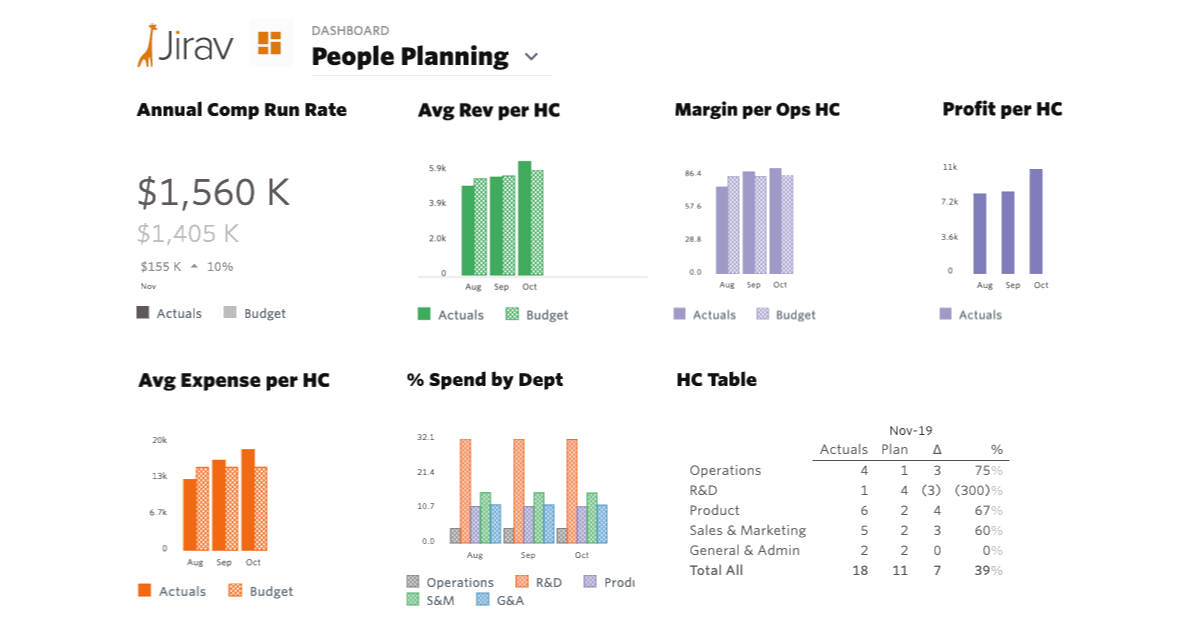
The firms that win advisory tailor the metric set to the client’s business model. A SaaS client lives or dies by net revenue retention and CAC payback. A professional services client cares about utilization and effective rate. An ecommerce client watches contribution margin and customer acquisition cost. Building the right industry-specific metric set, rather than handing every client the same generic dashboard, is a large part of what clients are actually paying for. A metrics library that lets you assemble the right KPIs per client, in both actuals and forecast, is what makes that practical.
Delivering KPIs at Scale
Here is the part that separates intention from practice. The bottleneck is rarely knowing which KPIs matter. It is producing them for ten, thirty, or fifty clients every single month without building a custom spreadsheet for each one. That is where most firms’ advisory ambitions stall.
Purpose-built FP&A software is the answer to the scale problem. Jirav delivers pre-built and custom KPIs in both actuals and forecast, dashboards that assemble themselves from integrated accounting and operational data, and a standard package you can roll out to every client and then tailor at the edges. The planning and forecasting engine means the KPIs you show are forward-looking, not just a rear-view mirror.
Compass East, a Nashville-based virtual firm, is a clear example. It onboards every new client to a standard Jirav dashboard, customized to its client-management approach, then tailored per client. Reports and board packages that once took hours now generate in seconds, and the firm credits that standardized, KPI-driven delivery with doubling its average new client fee. Their full case study is worth a read if you are building toward the same model.
The Same Discipline, Both Directions
The principle is identical whether you are looking inward at your firm or outward at a client: measure what drives decisions, deliver it on a reliable cadence, and act on it. Firms that apply that discipline to their own practice tend to be the ones who deliver it best to clients, and the 2024 CAS data suggests they are also the ones growing fastest.
If you want to see how firms standardize KPI delivery across an entire client base, explore the Jirav accounting partner program or request a demo.