

Client advisory services is one of the few terms in the profession that means two different things depending on who is saying it. To some firms, CAS is the back-office stack: bookkeeping, payroll, bill pay, monthly close. To others, it is the strategic layer: cash flow management, forecasting, KPIs, and the standing advisory relationship that sits on top of clean books. Both definitions are in active use, and the gap between them is precisely where the growth is.
If your firm already delivers some version of advisory work, the useful question is not "what is CAS." It is where your practice sits on the maturity curve, and what it takes to move up that curve deliberately rather than by accident. That is the conversation CPA.com formalized as CAS 2.0.
CAS 1.0 and CAS 2.0, without the jargon
The cleanest way to read the two terms is as positions on a maturity model. CPA.com and the AICPA describe a progression from financial CAS to business insights CAS. Financial CAS, often labeled CAS 1.0, is cloud-based accounting delivered through a standardized dashboard: monthly statements, controller-level oversight, reliable data. It is foundational, and it is not going away.
CAS 2.0 is the advisory layer built on that foundation. Journal of Accountancy describes it as the move from reporting what happened to advising on what comes next: cash flow planning, driver-based forecasting, scenario analysis, KPI and non-financial metric tracking, and benchmarking. The CPA.com maturity model breaks the advisory side into three rungs, from CFO finance to CFO business insights to trusted business advisor. The further up you climb, the less the work looks like accounting and the more it looks like strategy.
A concrete example helps. A client on financial CAS gets a clean monthly close and a dashboard of what happened. The same client on business insights CAS gets a rolling forecast, a quarterly scenario review tied to a real hiring or pricing decision, and a standing conversation about the handful of metrics that move their business. Same books underneath. Very different relationship, and a very different fee.
Critically, this is not a choice between the two. The transactional foundation is what makes the advisory layer credible. Firms that try to sell foresight on top of unreliable data do not keep clients long.
Why the shift is worth making now
The benchmark data makes the case more clearly than any pitch. The 2024 CPA.com and AICPA PCPS CAS Benchmark Survey found CAS practices reporting a median growth rate of 17%, which continues to outpace overall firm growth and keeps CAS the fastest-growing service area in public accounting. Respondents projected another 15% in the following year.
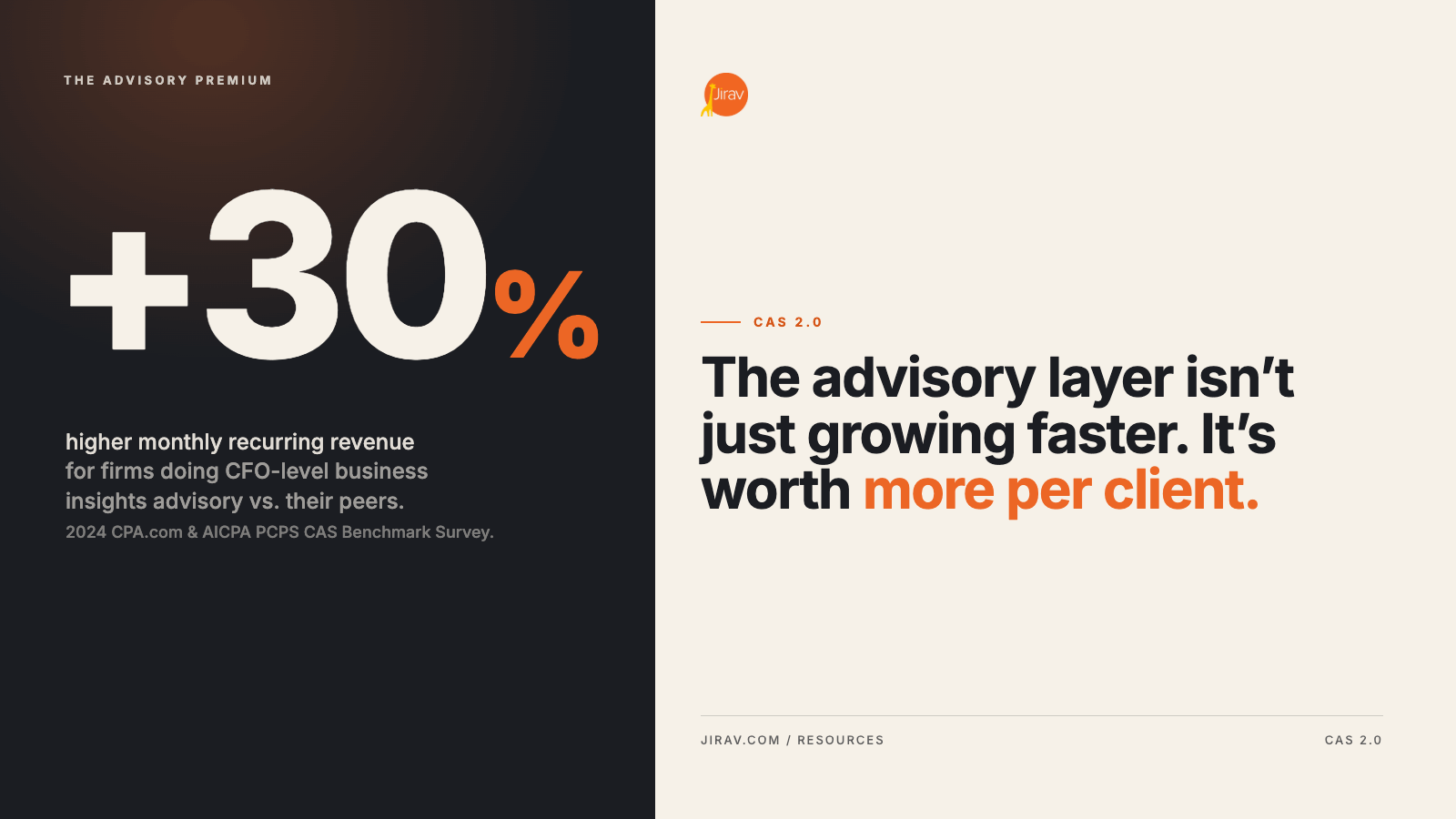
The more pointed finding is about where inside CAS the money sits. Firms generating significant revenue from CFO-level or higher business insights advisory earned more than 30% higher monthly recurring revenue than their peers. The advisory layer is not just growing faster, it is worth more per client. The same survey tied profitability to two habits that have nothing to do with accounting skill: practices with a formal written CAS business plan grew faster and earned more per client, and firms anchored to a defined industry niche reported materially higher revenue per client.
Two more findings are worth holding onto. Practices that continually invest in technology reported serving meaningfully more clients than the average respondent, a concrete link between the technology pillar and capacity. And growth is not evenly distributed across CAS practices: it concentrates in the firms that specialize, standardize, and invest in their stack. The takeaway is not that CAS grows. It is that intentional CAS grows, and undifferentiated CAS mostly keeps pace.
The CAS 2.0 framework: four pillars
CPA.com's CAS 2.0 framework organizes the move into four pillars. They are worth naming, because most firms are strong on one and quietly weak on the rest.
- Strategy and governance. Leadership alignment on a firm-wide CAS strategy. This sounds soft and is usually the real bottleneck, because CAS competes with tax and audit for partner attention and staff time.
- Practice development. The business model itself: pricing, packaging, staffing metrics, an explicit ideal-client definition, and a sales motion. This is where the written business plan the benchmark rewards actually lives.
- Technology. An integrated tech stack rather than a pile of disconnected tools, covering how data flows from the general ledger into reporting and planning.
- Operational excellence. Standardized processes, upskilling, and client onboarding that let the practice scale without re-inventing the work for every engagement.
The pillars are easier to act on if you read them in order rather than as a checklist. Strategy and governance decides whether CAS gets real partner sponsorship or stays a side project. Practice development turns that mandate into a priced, packaged service with a defined client. Technology gives that service the leverage to run at volume. Operational excellence keeps quality flat as the client count climbs. Skip the first two and the technology pillar becomes shelfware: a capable platform nobody has the mandate or the model to use.
The technology pillar is where modeling and reporting diverge
Most firms underinvest in the technology pillar in a specific way: they buy reporting and call it advisory. A dashboard that displays historical actuals supports CAS 1.0 well and CAS 2.0 barely. The advisory conversation a client pays a premium for is forward-looking, and forward-looking work requires a tool that can model, not just report.
This is where a driver-based platform like Jirav earns its place in the stack. Built for accounting and CFO advisory firms, it connects a client's accounting, workforce, and operational data and produces three-way forecasts that recalculate from the assumptions you control. You can build budgets and rolling forecasts, compare scenarios, and deliver reporting and KPI dashboards that sit on top of a live model rather than a static export. The model you use to run a what-if in a client meeting is the same model that feeds the dashboard, which is what keeps an advisory practice standardized as it scales.
Standardization is the quiet through-line of the benchmark findings. The firms that grow CAS profitably are not the ones with the most gifted individual advisors. They are the ones whose processes and technology let an average team deliver consistent advisory work across dozens of clients.
Where firms get stuck moving from 1.0 to 2.0
Three failure patterns show up repeatedly, and none of them is a skills problem. The first is selling foresight on top of a weak data foundation. A firm pushes forecasting and scenario work before the monthly close is reliable, the numbers move under the client mid-conversation, and the advisory relationship loses credibility before it starts. CAS 1.0 is the prerequisite, not the part you skip.
The second is pricing. Advisory delivered on hourly billing quietly caps itself, because the better you get, the faster you work, and the less you earn for the same insight. The benchmark firms that pull ahead price advisory as a fixed recurring package tied to outcomes, not hours. Moving a client from an hourly compliance arrangement to a packaged advisory retainer is as much a sales motion as a delivery one, and it is the step most firms underprepare for.
The third is staying a generalist. The survey is consistent on this: firms anchored to a defined niche earn more per client, because the same model, the same KPI set, and the same benchmarks get reused across similar businesses. A firm serving every industry rebuilds the work each time. A firm that owns dental practices or SaaS startups builds once and refines forever.
What this looks like in practice
Firms making this move tend to show the same pattern: a defined service package, a repeatable model template, and a monthly cadence that turns reporting into advice. Compass East doubled its average new client fee after shifting to FP&A advisory services on Jirav, a direct illustration of the revenue-per-client premium the benchmark describes. Summit Virtual CFO by Anders uses live modeling during client meetings to support a 94% retention rate, which is the retention side of the same coin. Advisory relationships are simply harder to leave than reporting relationships.
What is worth noticing is that neither example depends on individual heroics. The fee premium and the retention come from packaging and repeatability: a defined deliverable, the same model template applied client to client, and a standing cadence that makes the advisory conversation a habit rather than a project. That is what makes the result reproducible across a team instead of trapped in one partner's head.
Getting intentional
The throughline of CAS 2.0 is that the growth does not come from working harder on compliance. It comes from building the strategy, the business model, the technology, and the operations that let a firm move up the advisory curve on purpose. If your firm is already doing advisory work informally, the opportunity is to formalize it: write the plan, pick the niche, standardize the model, and choose technology that can carry forward-looking work.
None of that requires a firm-wide overhaul to begin. The lowest-risk start is to pick three existing clients who already lean on you for more than compliance, build a standardized forecast-and-KPI package for them, price it as a recurring retainer, and run it for a quarter. That pilot surfaces the real gaps in your pricing, your process, and your stack faster than any planning exercise, and it gives you a proven template to roll out to the rest of the book.
To see how the modeling layer of a CAS 2.0 stack works in practice, you can explore Jirav's platform for accounting and advisory firms or request a walkthrough.