

The seven challenges, up front
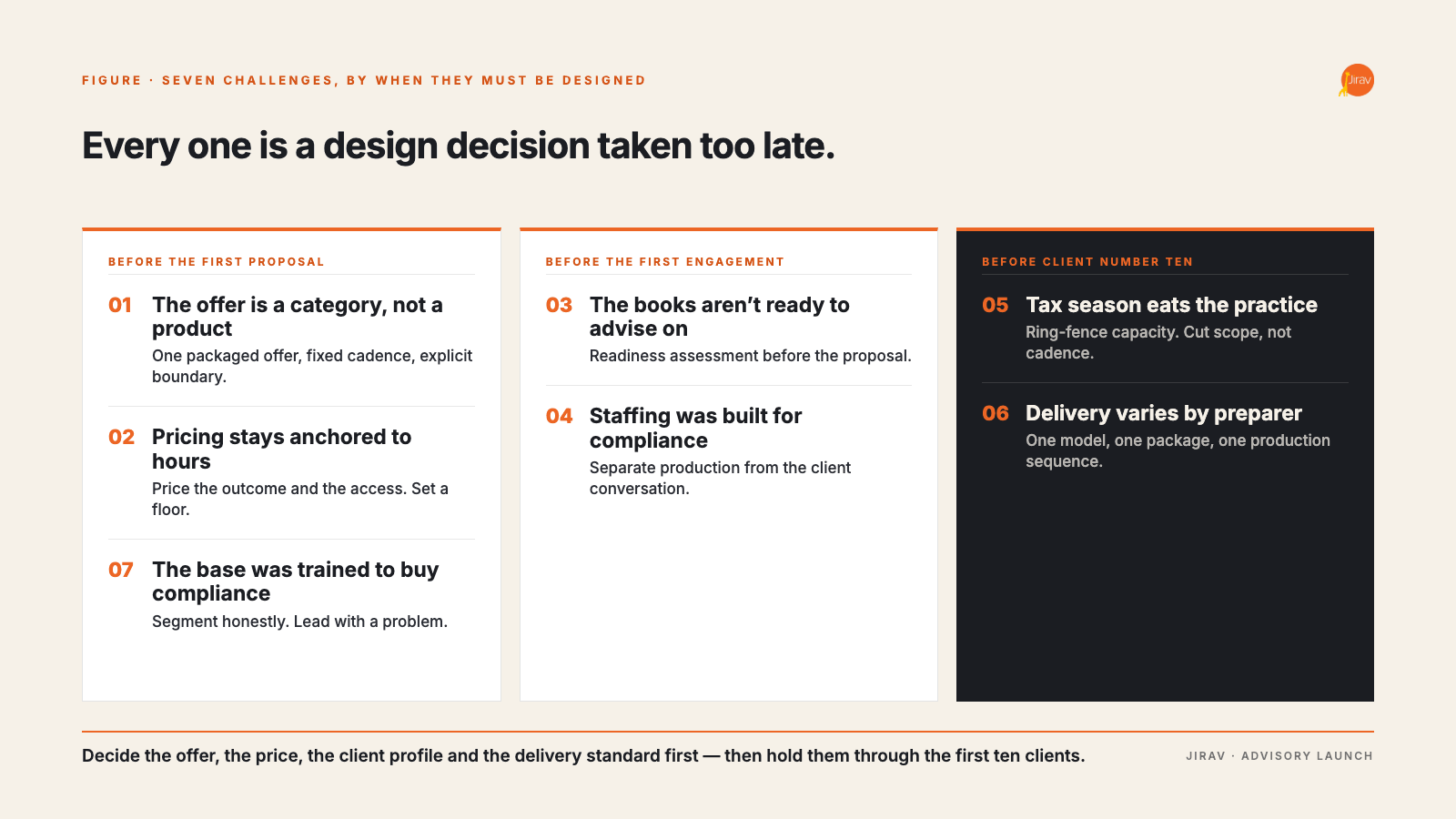
Accounting firms launching advisory services consistently stall on the same seven problems: an undefined offer that invites scope creep, pricing that stays tied to hours, clients whose books are not ready to advise on, a staffing model built for compliance work, capacity collisions with tax season, delivery that varies by preparer, and a client base conditioned to buy compliance. None of them are solved by deciding to do advisory. All of them have to be designed around before the first engagement.
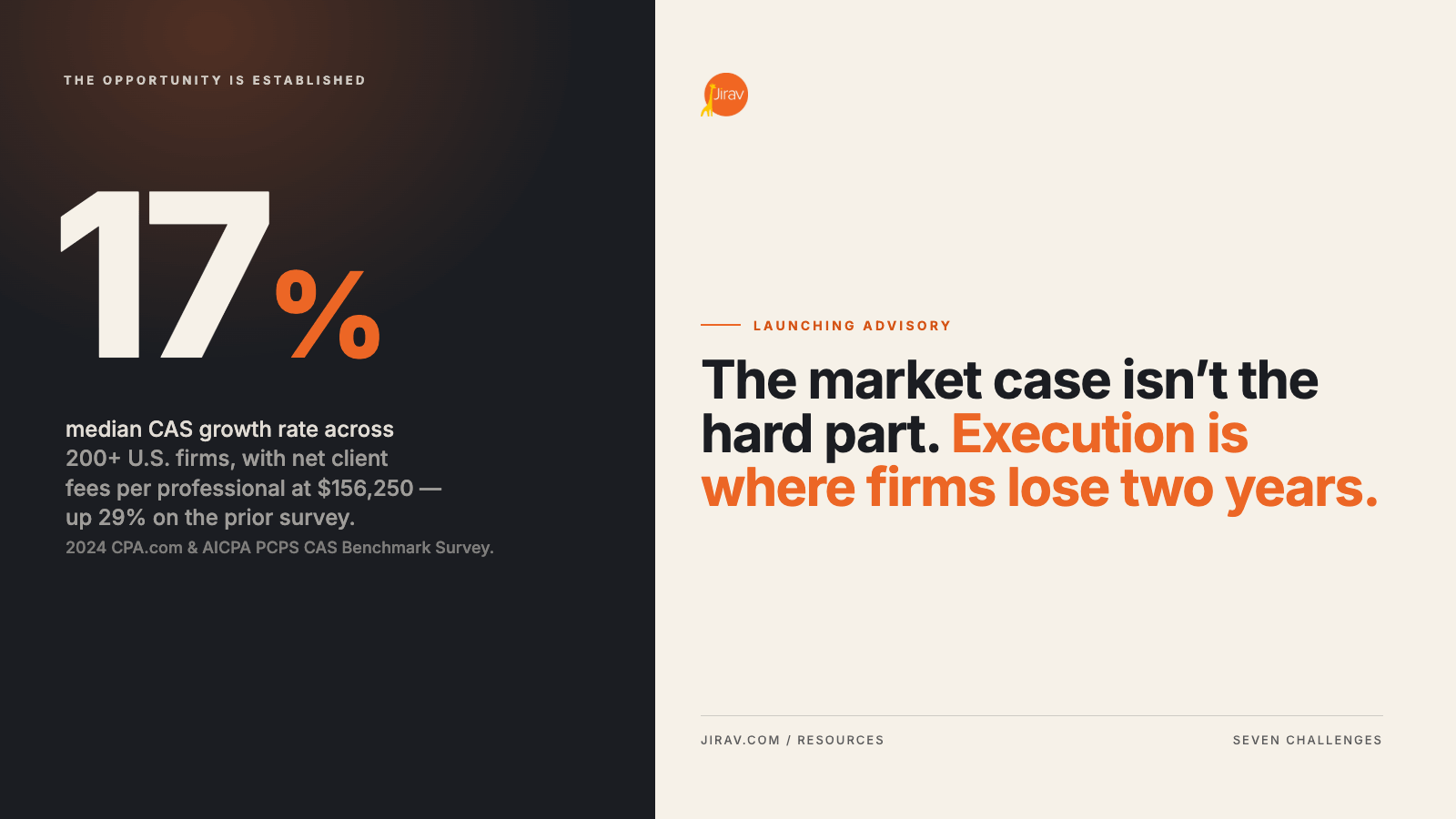
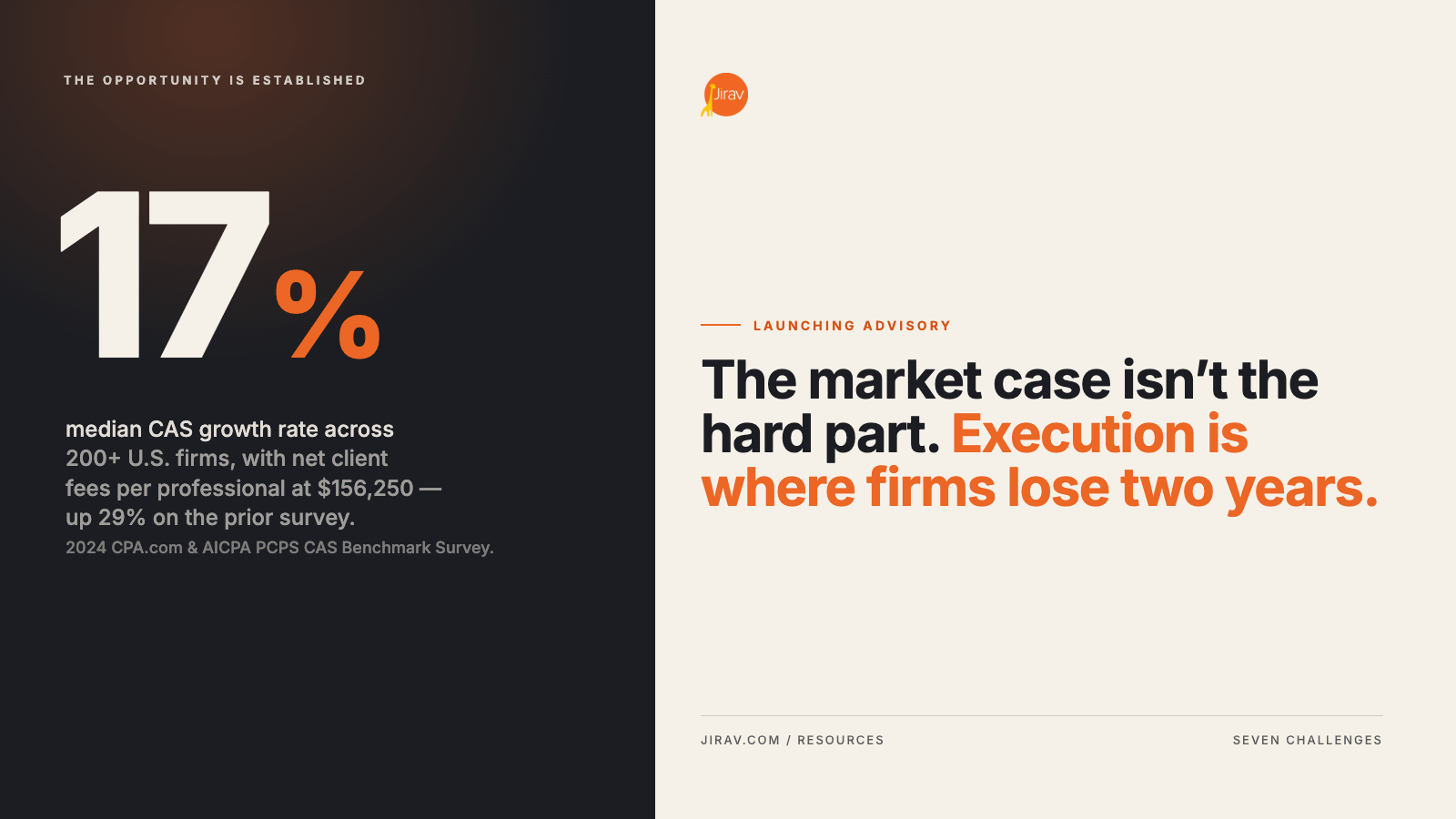
The market case is not the hard part. The 2024 CPA.com and AICPA PCPS CAS Benchmark Survey, covering more than 200 U.S. firms, reported a median CAS growth rate of 17% and median net client fees per professional of $156,250, a 29% increase over the prior survey. Participating firms projected a median 99% growth rate over the following three years. The opportunity is established. Execution is where firms lose two years.
Challenge 1: The offer is a category, not a product
"Advisory services" is not something a client can buy. It describes an intent. Firms that launch with a category rather than a defined offer end up delivering whatever each client asks for, which is the definition of an unscalable practice.
The symptom is unmistakable: every engagement looks different, nobody can describe the service in a sentence, and the proposal takes three hours to write because it is being invented each time.
What resolves it
Define one packaged offer with a named deliverable, a fixed cadence, and an explicit boundary. For most firms, the first offer should be a monthly financial package plus a rolling forecast plus a scheduled review call. Write down what is included, what is not, and what triggers a scope conversation.
One offer, delivered the same way to ten clients, teaches you more in six months than ten custom engagements teach in two years. Expand the menu after the first offer is genuinely repeatable, not before. The practical map of what actually counts as CAS is a useful boundary-setting exercise if the definitional question is still open internally.
Challenge 2: Pricing stays anchored to hours
Firms rarely fail to raise advisory prices out of ignorance. They fail because the pricing instinct built over twenty years of compliance work is cost-plus, and advisory value does not correlate to time spent. The strongest advisory conversation in a given month might take forty minutes.
Hourly pricing on advisory work also creates a perverse incentive: the more efficient the firm becomes, the less it earns, which is precisely backwards for a practice whose margin depends on templating and reuse.
What resolves it
- Price the outcome and the access, not the hours. The client is buying a forecast they can run the business on and a CFO-level conversation every month.
- Set a floor and hold it. A monthly fee below roughly $1,500 rarely supports genuine advisory delivery once the production cost is honest. Firms that start too low spend years repricing.
- Price on complexity drivers, not size alone: entity count, transaction volume, systems, and how many stakeholders need reporting.
- Build annual increases into the engagement letter from the start. Retroactive repricing conversations are far harder than contractual ones.
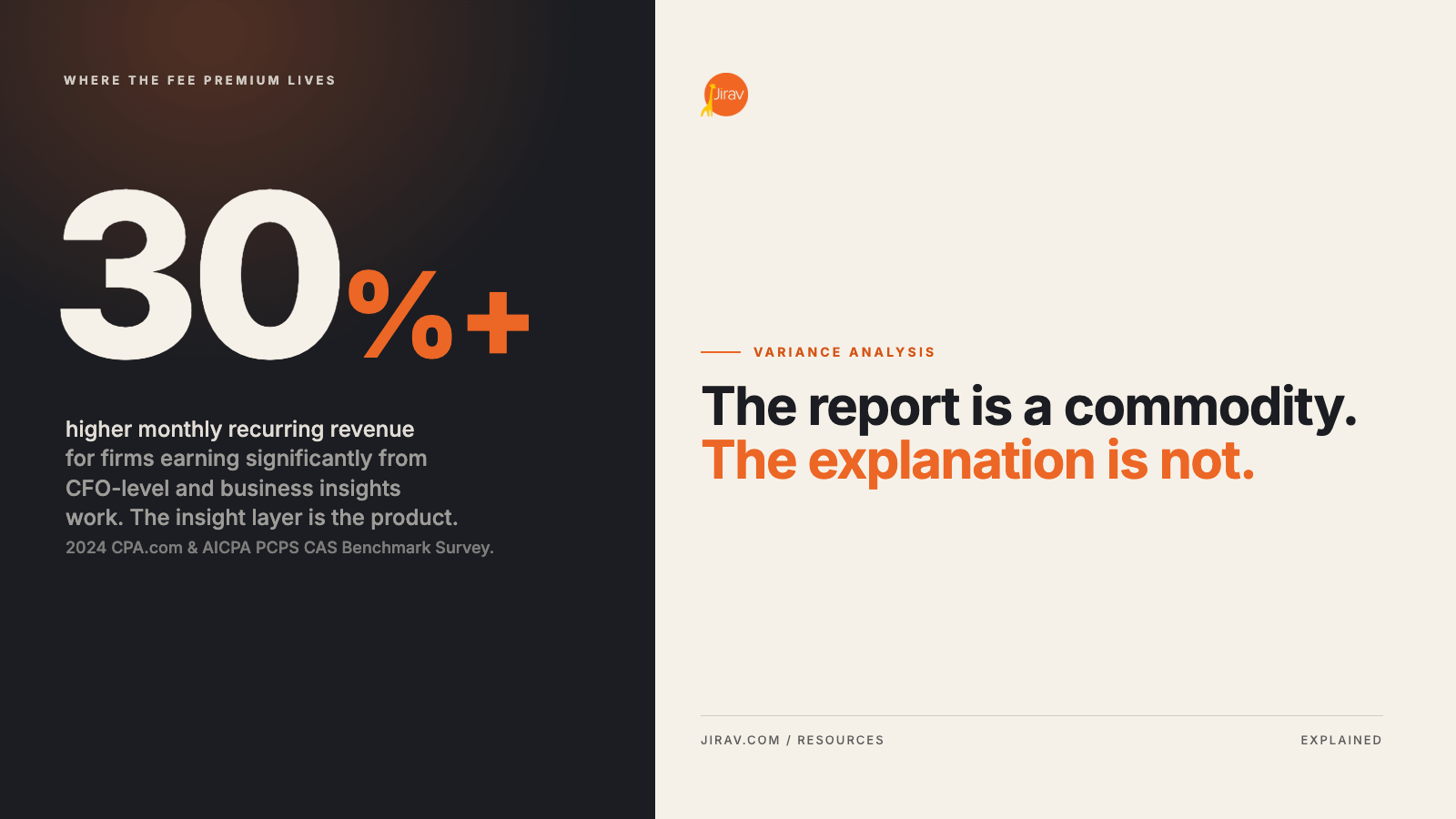
The benchmark data supports pricing confidence. The CAS survey found that the smaller group of firms generating significant revenue from CFO-level and business insights work reported more than 30% higher monthly recurring revenue and typical monthly fees more than 30% higher than peers. The premium exists and is measurable.
Challenge 3: The client’s books are not ready to advise on
This is the most underestimated obstacle in the entire launch. Advisory work is downstream of accounting quality. A firm that sells a forecast to a client whose books close six weeks late, whose chart of accounts has no departmental structure, and whose balance sheet has unreconciled accounts has sold a deliverable it cannot produce.
The result is a first ninety days spent on cleanup that was not scoped, at a fee that assumed advisory work, which poisons the engagement economics and usually the client relationship too.
What resolves it
Build a readiness assessment into the sales process and run it before the proposal, not after. The minimum bar:
- Close completed within ten business days of month end
- Chart of accounts with departmental or class-level structure
- Balance sheet accounts reconciled monthly, not annually
- Revenue recognized on a consistent basis
- Payroll and accounting systems that can connect to the planning layer
When a client fails the assessment, sell the cleanup as a separately priced project with a defined end, then start advisory. This is not a delay tactic. It protects the advisory engagement from inheriting a problem it was never priced to absorb, and it produces a second revenue line.
Client-side context: Conditions are tightening for the businesses being advised. The Federal Reserve Banks’ 2026 Report on Employer Firms found expectations for revenue and employment growth falling to their lowest levels since the 2020 survey, with 77% of firms reporting rising costs, tariff-related increases, or both. Demand for forward-looking guidance is rising precisely as the underlying businesses get harder to forecast.
Challenge 4: The staffing model was built for compliance
Compliance work rewards accuracy, deadline management, and technical precision. Advisory work rewards judgment, comfort with ambiguity, and the ability to hold a conversation with an owner about a decision that has no clean answer. Those are overlapping but distinct capability sets, and the overlap is smaller than most firms assume.
Two failure patterns recur. The first is assigning advisory to the most technically strong preparer, who then struggles with client-facing ambiguity. The second is hiring an external CFO-level person with no firm infrastructure around them, who spends a year building basic process alone.
What resolves it
- Separate the roles. A production role builds the model and package. A client-facing role runs the conversation and makes recommendations. One person can do both at three clients and cannot at fifteen.
- Promote from inside where possible. Staff who already know the client base have most of the context. What they usually need is structured practice at the conversation, not more technical training.
- Start the client-facing person with three engagements, not ten. Advisory capability compounds through repetition with feedback. Volume before competence produces inconsistent delivery, which is challenge six.
Discomfort with the advisory conversation itself is common and specific enough to address directly. Jirav has written on eliminating the FP&A fear factor for teams working through exactly that transition.
Challenge 5: Tax season eats the practice
Every firm with a compliance base hits this in its first January. Advisory engagements are monthly commitments. Tax season is a ten-week capacity event. Without explicit protection, the advisory work gets deferred, clients notice the gap, and the practice loses the momentum it took a year to build.
The damage is disproportionate to the delay. A client who receives no package in February and March learns that advisory is the part of the relationship that is optional.
What resolves it
- Ring-fence advisory capacity. Named people, on advisory only, through the season. Shared capacity is not capacity.
- Reduce scope rather than cadence. A shorter package delivered on time preserves the relationship. A full package delivered in April does not.
- Front-load the work. Templated packages and connected data mean the January and February production can largely be built in December.
- Tell clients in advance. A stated seasonal adjustment agreed in November is a professional arrangement. The same reduction discovered in February is a service failure.
Challenge 6: Delivery varies by whoever produced it
By client number eight or ten, most firms discover that the packages look different, take different amounts of time, and vary in quality by preparer. Every engagement carries its own spreadsheet model, built by whoever set it up, maintained by whoever inherited it.
That inconsistency has three costs, and they compound. Margin becomes unpredictable, because production time varies by a factor of two or three across engagements. Quality becomes staff-dependent. And methodology improvements cannot be deployed, because applying a better approach means rebuilding ten separate models by hand.
What resolves it
Standardize the model and the package before scaling the client count. Practically:
- One template model structure, with a small number of industry variants rather than a variant per client
- One reporting package format, with the client name being close to the only difference
- A documented monthly production sequence with an explicit checklist
- A single place where actuals connect, so no engagement depends on a manual export
This is the point where tooling changes the economics rather than the method. Jirav is built around this specific pattern for advisory firms: connected actuals from the general ledger, payroll, and operational sources so the monthly refresh is not a manual export; driver-based planning with headcount modeled as its own layer; three-statement output generated rather than assembled; and a partner console that lets a firm build a model and reporting package once and deploy it across the client book. Auto Forecast generates a baseline projection from historical data, seasonality, and trend, so the starting point on a new engagement is produced rather than built from scratch.
The point is not the software. It is that a firm cannot sell a repeatable product while producing a bespoke deliverable, and the gap between those two is where advisory margin disappears. Firms that have made this transition generally standardized delivery before they grew the book, not after. Firms working through this stage with support rather than alone often start through an accounting partner program.
Challenge 7: The existing client base was trained to buy compliance
Firms often assume their compliance clients are the natural advisory market. Some are. Many were specifically chosen, years ago, because they wanted an accurate return at a fair price and no more contact than necessary. Selling a $3,000 monthly engagement to a client who has spent a decade buying a $1,200 annual return is a repositioning problem, not a sales problem.
The failure mode is a firm-wide announcement that advisory is now available, followed by low conversion and a conclusion that the market is not there.
What resolves it
- Segment the base honestly. Score clients on growth, complexity, owner engagement, and willingness to pay. Most firms find that 10% to 20% are genuine advisory candidates. That is a workable pipeline, not a disappointment.
- Lead with a problem, not a service. "Your cash position swings hard in Q3 and we can model it" converts. "We now offer advisory services" does not.
- Use a paid diagnostic as the entry point. A scoped, fixed-fee engagement (a thirteen-week cash forecast, a pricing analysis) demonstrates the work and converts far better than a proposal for an ongoing commitment.
- Expect to acquire new clients too. The best advisory clients frequently were never compliance clients. Firms that treat advisory as purely a base-monetization play cap themselves early. Jirav has covered the broader demand shift in how firms can monetize changing client expectations.
What to solve first
The seven are not independent, and sequence matters more than effort. Attempting all of them simultaneously is the most common way a launch stalls.
|
Stage |
Solve |
Because |
|---|---|---|
|
Before the first client |
Challenge 1 (define the offer) and Challenge 2 (set pricing) |
Both are nearly impossible to change retroactively across an existing book |
|
Clients 1 to 3 |
Challenge 3 (readiness screening) and Challenge 7 (segmentation) |
Wrong-fit clients acquired early set the reference price and the delivery expectation |
|
Clients 4 to 10 |
Challenge 6 (standardize delivery) |
This is where bespoke delivery starts consuming margin, and it is still cheap to fix |
|
Clients 10 and beyond |
Challenge 4 (staffing model) and Challenge 5 (seasonal capacity) |
Both become binding constraints only once volume exceeds what the founding partner can personally carry |
What to measure
Advisory practices that stall usually measured nothing but revenue for the first year. The metrics that reveal problems early:
- Net client fees per professional. The CAS benchmark median was $156,250. Well below it usually signals a pricing or a production efficiency problem.
- Production hours per client per month. Track it from engagement one. Variance across clients is the earliest signal of the standardization problem.
- Realization on advisory engagements specifically, separated from compliance work.
- Client retention at the twelve-month mark, which is where value either got demonstrated or did not.
- Percentage of revenue from business insights work versus transactional CAS, since that mix is what the fee premium tracks to.
The KPIs every accounting firm should track covers the broader firm-level set, and building an internal KPI dashboard is worth doing for your own practice before you sell one to a client.
The pattern across all seven
Every one of these challenges is a design decision taken too late. Firms that launch advisory well decide the offer, the price, the client profile, and the delivery standard before the first engagement, then hold those decisions through the first ten clients. Firms that struggle decide to do advisory and work the rest out per client.
The market opportunity is not in question. What separates firms is whether advisory gets built as a product or accumulated as a collection of favors.
|
Build advisory delivery you can actually repeat Jirav gives accounting and CFO firms connected actuals, driver-based planning, and a partner console for deploying one model and one reporting package across the entire client book. |