

Most finance teams can read a SaaS income statement. Far fewer can model one that holds up when the board asks what happens to cash if growth slows and you pull forward three engineering hires at the same time.
SaaS finance is structurally different from finance in almost any other kind of business. Revenue does not arrive and leave in the same period. It compounds, it churns, it expands, and it sits on the balance sheet as deferred revenue long after the cash has cleared. A model built for a company that sells a product once and recognizes it once will quietly mislead you the moment recurring revenue enters the picture.
This guide is for finance leaders and advisors who already understand three-statement modeling and want a clear view of what actually changes when the business runs on subscriptions: which metrics drive decisions, how to build a model that survives contact with reality, and how to forecast when the target keeps moving.
Why SaaS FP&A Is a Different Discipline
The defining feature of SaaS is that a sale is not an event, it is the start of a stream. That single fact reshapes the whole financial picture.
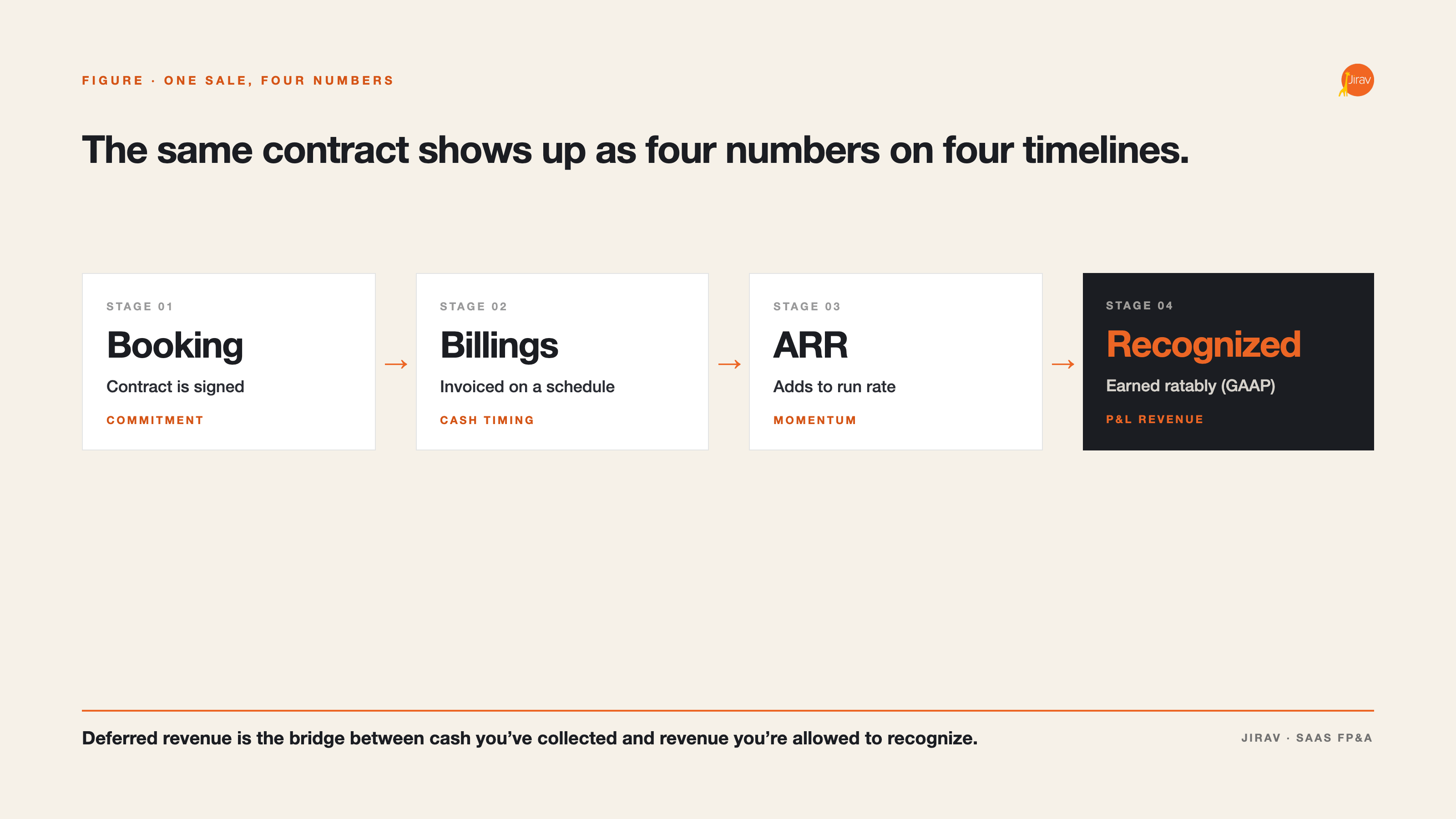
Bookings, billings, ARR, and recognized revenue are four different numbers, and confusing them is the most common modeling error in SaaS. A customer can sign a contract (a booking), get invoiced on a schedule (billings), add to your run rate (ARR), and have revenue recognized ratably over the term (GAAP revenue), with cash arriving on yet another timeline. Deferred revenue is the bridge between the cash you have collected and the revenue you are allowed to recognize.
The base also changes shape every month. Existing customers expand, contract, and churn, so the revenue you start the period with is never the revenue you end with. This is why you cannot forecast SaaS revenue by drawing a trend line through last year. You have to model the motion of the customer base itself.
The Metrics That Actually Drive Decisions
There are dozens of SaaS metrics. The ones worth putting on a management dashboard are the five to seven that change a decision. They fall into three groups: growth, retention, and efficiency.
Growth: composition matters more than the headline
ARR and MRR are the run-rate view of the business, but the headline number hides the story. What matters is the composition of net new ARR: how much came from new logos, how much from expansion within existing accounts, and how much was given back through contraction and churn. Two companies can post identical net new ARR while one is acquiring its way out of a leaky bucket and the other is compounding a loyal base. Only one of those is healthy.
Retention: the floor and the engine
Gross revenue retention (GRR) is the floor: how much of last year's revenue you keep before any expansion. Net revenue retention (NRR) is the engine: it includes expansion, so an NRR above 100% means your existing base grows even if you never sign another customer. The catch is that strong expansion is rarer than pitch decks suggest. According to SaaS Capital's annual private-company survey, the median private SaaS company posts net revenue retention only modestly above 100%, which means most companies are barely outrunning churn. Treat NRR as the single highest-leverage number in the model.
Efficiency: what the market now rewards
CAC payback (months to recover the cost of acquiring a customer), the SaaS magic number (new ARR generated per dollar of sales and marketing), and the burn multiple (net burn per dollar of net new ARR) all measure the same underlying question: how efficiently does growth convert spend into durable revenue. Sitting above them is the Rule of 40: a company's revenue growth rate plus its profit margin should clear 40%. It is a useful North Star precisely because it forces growth and profitability into the same sentence. Worth knowing how high the bar sits: SaaS Capital's data shows the median public SaaS company has been scoring well below 40 in recent quarters, so clearing it is a genuine signal, not table stakes.
Pick the handful of these tied to decisions you will actually make this year. A dashboard with thirty metrics is reporting. FP&A is the subset that changes what you do.
Building a SaaS Model That Holds Up
A durable SaaS model is driver-based and built from the bottom up. Instead of typing a revenue growth rate into a cell, you model the levers that produce revenue: new bookings by segment, sales capacity and ramp, win rates and average deal size, and the churn and expansion rates that reshape the base.
Start with the ARR roll-forward, the spine of the whole model: beginning ARR, plus new, plus expansion, minus contraction, minus churn, equals ending ARR. Then translate that run rate into GAAP revenue using your recognition rules, carrying deferred revenue correctly. Get this right and the rest of the model has a reliable foundation.
Headcount is the second engine. In SaaS, people are usually the largest cost, so model the hiring plan by function with ramp time and fully loaded cost, tied directly to the revenue plan rather than bolted on as a flat percentage. Finally, make the three statements tie out. ARR is not cash. Billing terms, collections timing, and deferred revenue drive the cash line, and a model that forecasts only the income statement will answer every question except the one about runway.
Forecasting When the Target Keeps Moving
The annual budget anchors the year, but it is stale within a quarter. A rolling forecast keeps the picture current by re-forecasting on a regular cadence (monthly is the right rhythm for most SaaS businesses) as real bookings, churn, and hiring land. The budget says what you committed to; the rolling forecast says where you are actually headed.
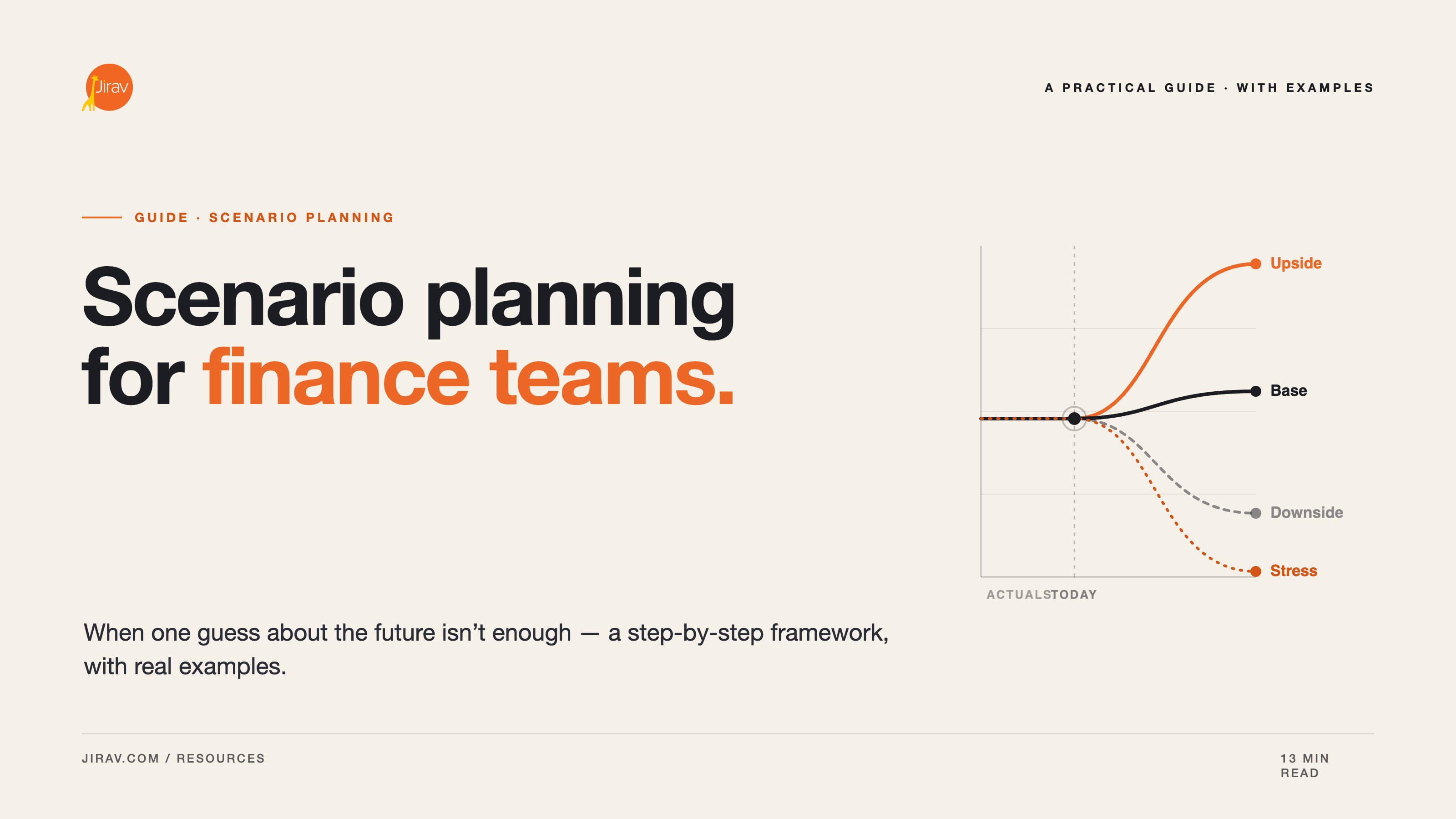
Layer scenario planning on top. Model the decisions you might genuinely face: hiring ahead of plan, growth coming in 20% light, a pricing change, or a churn spike in a key segment. Maintain a base case, an upside, and a downside, and look at each across all three statements. The point of a downside scenario is almost always the cash and runway answer, not the revenue line.
Where Spreadsheets Stop Keeping Up
Here is the honest part: most SaaS teams run all of this in Excel or Sheets, and it works, right up until it doesn't. The break points are predictable. The model takes the better part of a day to update. Only one person fully understands it. The three statements quietly stop tying out. Version control collapses into a folder of files with names like final_v7_BOARD_USE_THIS. At that point the spreadsheet is no longer giving you leverage, it is consuming it.
This is where a purpose-built FP&A platform earns its place. Jirav forecasts the income statement, balance sheet, and cash flow together from your drivers, so cash is an output of the model rather than a separate guess. Its pre-built SaaS models give you a working starting point for sales, marketing, SaaS revenue, and retention, and its accounting and CRM integrations pull actuals in automatically so the base case stays current without manual exports.
From there, Auto Forecast rolls the model forward each period, the scenario engine lets you clone a base case and compare downside and upside side by side, and the Metrics Library handles SaaS KPIs in both actuals and forecast. The result is a model the whole team can run, board-ready reporting that assembles itself, and an end to the one-analyst single point of failure.
For Advisors Serving SaaS Clients
If you run a fractional CFO or FP&A advisory practice, the SaaS model is also your product. The leverage is standardizing it once and deploying it across clients, rather than rebuilding a bespoke model for every engagement. A standard SaaS dashboard and forecast, customized at the edges per client, is how firms add SaaS clients without adding proportional hours. You can see how advisory firms put that into practice in Jirav's customer stories.
The Bottom Line
The companies that plan well in SaaS are not the ones with the most metrics. They are the ones whose model connects drivers to ARR to cash, updates without heroics, and answers the next question before the board asks it. If your spreadsheet is starting to fight back, see how Jirav handles SaaS forecasting.