

Client retention in the virtual CFO space is notoriously hard to sustain at scale. Firms add clients through referrals and outreach, then watch churn eat into the book as clients grow past what the firm can support, find cheaper alternatives, or simply stop seeing the value in monthly financial reporting they could get from their bookkeeper.
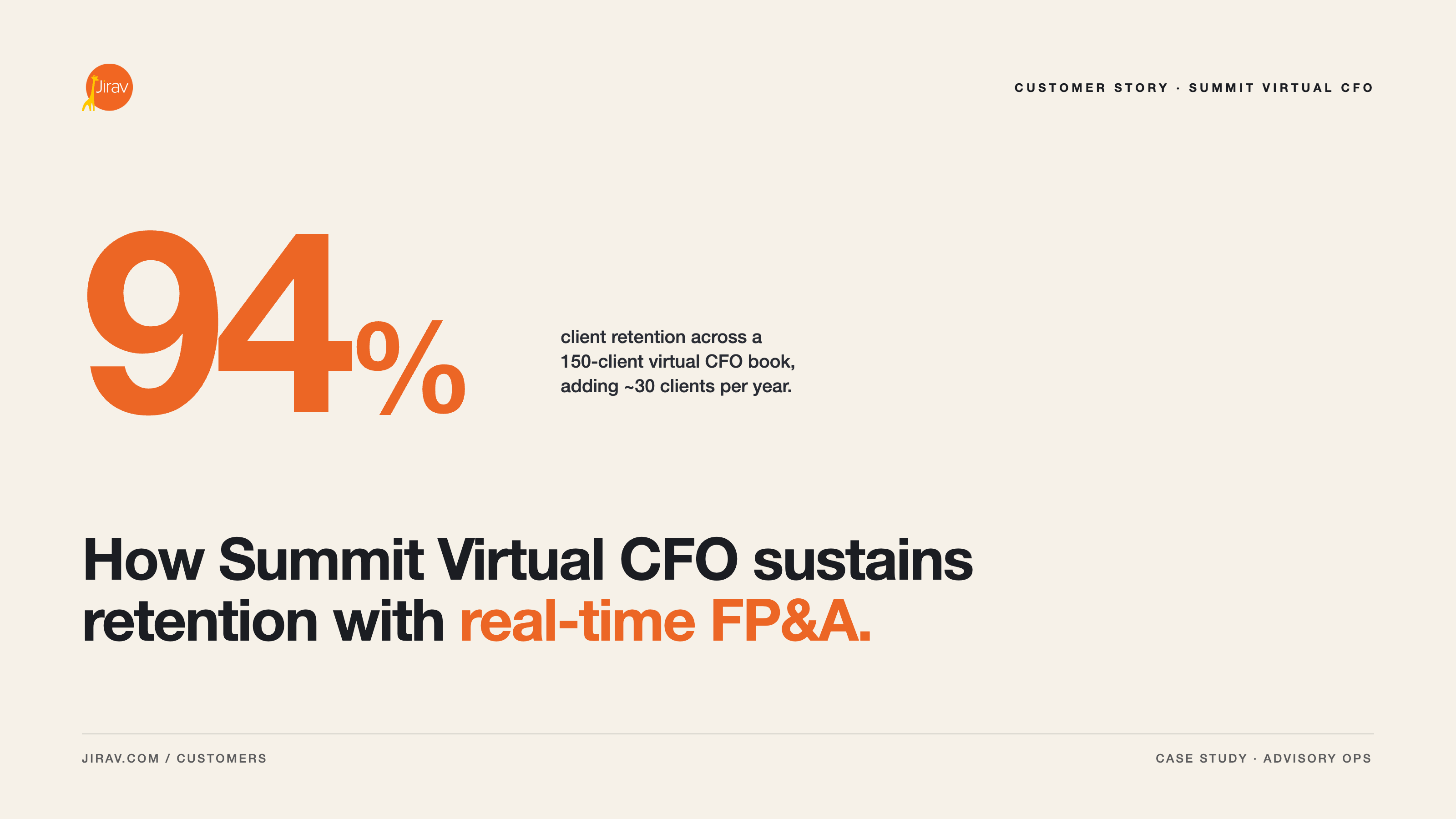
Summit Virtual CFO, now with Anders CPAs + Advisors (formerly Summit CPA Group), has built a different kind of operation. The firm serves 150 clients, adds approximately 30 new clients per year, and maintains a 94% client retention rate. It has done this while running fully remote with 55 US-based professionals and 15 part-time international staff members.
That retention number isn't an accident. It's the result of a deliberate service delivery model built around weekly client meetings, real-time financial modeling, and the kind of forecasting depth that turns a CFO engagement from a reporting subscription into a genuine advisory relationship.
This is how they do it, and what other virtual CFO and fractional CFO practices can learn from the approach.
The Service Model Behind the Retention Rate
Most virtual CFO firms operate on a monthly cadence: close the books, produce a reporting package, schedule a one-hour review. The relationship is valuable, but it's reactive. Clients get a retrospective on last month's performance and a brief look at the current period.
Summit runs differently. Their professionals meet with clients every week. Those meetings aren't status checks. They're working sessions where advisors and clients build and update financial models together, explore what different decisions will mean for cash flow and runway, and develop the kind of shared understanding of the business that makes strategic guidance credible.
That meeting cadence requires two things: advisors who are skilled enough to model live in front of clients, and tools that can support live modeling without breaking down.
For years, Summit operated on a desktop-based FP&A solution that was functional but increasingly fragile. The firm could deliver forecasts. What it couldn't deliver, at scale, was the kind of real-time collaborative planning that makes a client feel genuinely guided rather than serviced.
The Breaking Point: When Desktop Tools Hit Their Limits
The cracks started appearing in 2019. A major operating system update triggered file management problems across the firm's desktop FP&A platform. Files were getting corrupted. Recovering previous versions became a recurring time cost. The stability that a high-touch client engagement model depends on started to look uncertain.
But the stability issue wasn't the only problem. Summit's advisors were delivering forecasts and presenting visualizations in client meetings. The outputs were technically solid. The clients, however, felt like the forecasts were coming from a black box.
Jake Grimm, Summit's Director of Technology, described the situation: clients could see the forecast output but couldn't get to the assumptions underneath. When they wanted to understand why a particular revenue projection looked the way it did, or explore an alternative scenario, the tools didn't support that conversation in real time.
A firm running weekly advisory meetings can't sustain a model where the advisor takes client questions, goes away to run the numbers, and comes back a day later with a new version. The value of weekly meetings is the immediacy. That requires a platform that can model on the fly, in a live session, with the client watching.
Evaluating Cloud-Based Alternatives
Summit evaluated three of the leading cloud-based FP&A platforms before selecting Jirav. Firm leaders were looking for several things that their desktop solution couldn't provide:
- Cloud reliability: no file corruption, no version management problems, no dependency on local operating system updates
- Forecast transparency: clients needed to be able to see the assumptions driving the numbers, zoom in on specific drivers, and understand the model without an extended explanation
- Live modeling capability: advisors needed to build and adjust models in real time during client calls, not present static outputs
- Collaborative flexibility: the platform needed to work for advisors who preferred to work directly with clients in a shared environment, not just produce polished packages after the fact
Jirav met those requirements. Grimm noted the firm appreciated Jirav's collaborative posture, including their openness to working with Summit on developing new features and capabilities as Summit's needs evolved.
Summit piloted Jirav with 10 to 15 clients in early 2020. After a successful pilot, they set out to roll the platform across the rest of their client base at 20 clients per month.
What Changed in Client Meetings
The shift to Jirav changed the texture of Summit's client meetings in ways that went beyond stability and access.
The most significant change was the ability to model live. Where Summit advisors previously worked from prepared outputs, they now build and update financial models directly in client sessions. Tom Wadelton, one of Summit's virtual CFOs, described what that looks like in practice: rather than presenting a forecast and explaining the methodology afterward, advisors are working through the model with the client, adjusting assumptions in real time and showing the downstream impact across revenue, cost of goods, operating expenses, and net income as the conversation develops.
“In Jirav, that kind of information is presented much like an income statement, which makes it easy for us to zero in on four or five key lines.”
Tom Wadelton, CPA, CGMA, MBA | Virtual CFO, Summit Virtual CFO
The transparency that live modeling enabled addressed the black-box problem that had persisted even when Summit was building forecasts directly in front of clients. Clients who watched the model being built were still sometimes uncertain about how the final numbers came together. With Jirav's income-statement-style presentation, advisors can pull up any line in the model and expand the drivers underneath it, in real time, without breaking the flow of the conversation.
After the meeting, clients retain access to the same model in the cloud. They can log in, review the current numbers, drill into assumptions, and come to the next meeting already oriented. The shared working environment reduces the amount of time each session spends on orientation and increases the time available for actual planning.
The Results: Scale Without Sacrifice
Summit has rolled Jirav out to over 80 of its 150 clients, with more added every month. The platform is one of the central enablers of the firm's ability to grow its client base without proportional headcount increases.
What makes the Summit model work at scale is the combination of a rigorous service delivery standard (weekly meetings, live modeling, forward-focused conversation) and a platform that can support that standard consistently across a growing portfolio. Advisory firms that want to grow without diluting service quality need both.
Wadelton's advice to firms considering the transition: start with one or two client forecasts to build platform confidence before moving into client-facing situations. The learning curve is real but short. Once advisors are comfortable modeling live, the quality of the advisory relationship shifts in ways that show up in retention.
Summit's 94% retention rate is the outcome of making clients feel guided, not just informed. That requires regular contact, a model that responds to the conversation in real time, and enough transparency that clients understand the basis for the advice they're receiving.
What This Means for Your Firm
Most fractional CFO and virtual CFO practices are already doing the core of this work. They're producing forecasts, running monthly reviews, and delivering financial guidance. The question is whether the tools they're using let them do that work at the level of depth and frequency that builds the kind of advisory relationship Summit has built.
If forecasts still live in Excel, the rollover process is manual, clients can't drill into assumptions on their own, and modeling scenarios requires offline work between meetings, those are capacity constraints that limit both service quality and firm growth.
The firms adding 30 clients a year without proportional staff increases are systematizing the delivery model, not just the technology. But the technology is the foundation that makes systematization possible.
If you're building or scaling an FP&A advisory practice, see how Jirav supports that model by requesting a demo.